From Clemson Plant Pathologist Tony Keinath
This year’s Fusarium wilt experiment includes 3 seedless cultivars, 3 fungicide treatments applied via drip irrigation, and grafting. This experiment is supported in part by a USDA SCRI grant. Transplants were set April 5 in a field infested with Fusarium races 1 and 2. These preliminary results are based on disease development 10 weeks after transplanting.
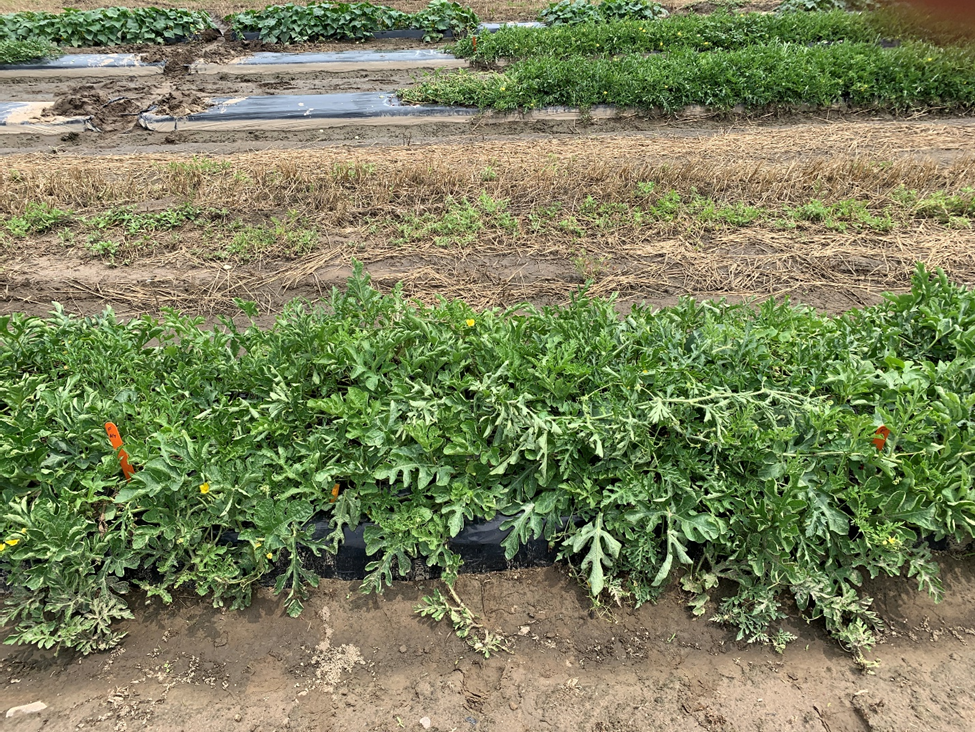
Symptoms of Fusarium wilt are still appearing on plants that looked heathy the previous week. Similar reports are coming in from commercial farms in the Bamberg-Barnwell area of South Carolina. At this point in the season, Fusarium wilt can most easily be recognized by wilting of an entire vine on a diseased plant.
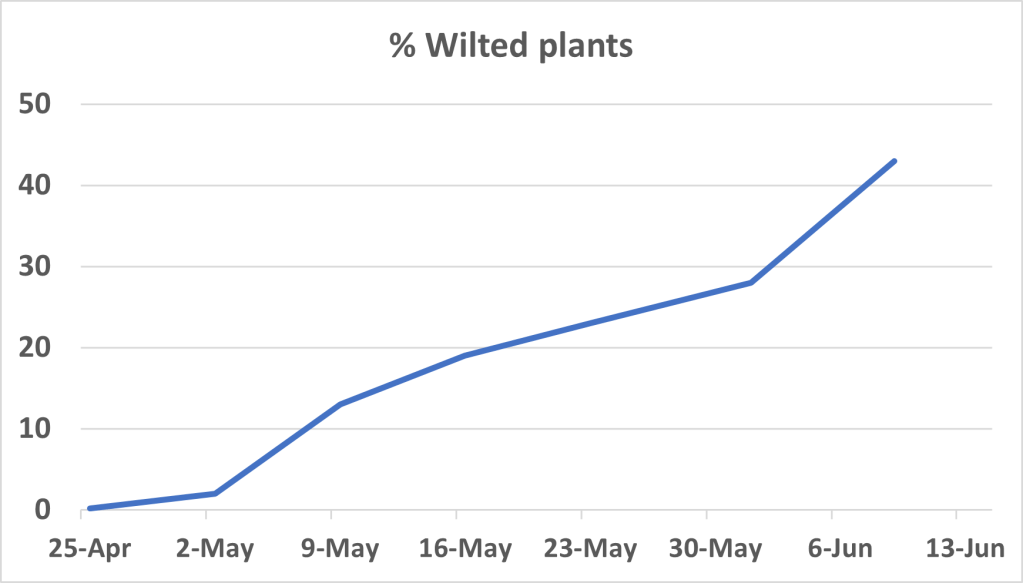
As you can see in the updated graph below, disease progress started to level off around May 30 but took off again before the most recent rating on June 9. The most likely reason is the cooler-than-normal temperatures, which are still somewhat favorable for Fusarium wilt.
At this point, the experiment is far enough along to report the following preliminary conclusions:
- The partially resistant cultivars Fascination and Eleanor (new in 2023) have less disease (48% for both) than the susceptible cultivar Shoreline (98%). (These percentages are for the non-treated controls without fungicides.)
- Fungicides are not working on either Fascination or Eleanor.
- Grafted cultivars have many, many fewer wilted plants (<1%) than non-grafted cultivars not treated with fungicides.
- Most importantly, grafted plants also have fewer wilted plants than non-grafted, fungicide-treated plants, which average 58% wilted plants.
Compared to previous years, fruit set is poor at this stage, except for a few crown set fruits, so the main harvest will start later than the usual third week of June.
 The South Carolina Grower