From Clemson Plant Pathologist Tony Keinath
A fall fungicide sensitivity bioassay was done in October 2023, to find out which fungicides are most effective against powdery mildew on squash, watermelon, and other cucurbits.
Methods: ‘Early Prolific’ yellow summer squash plants with three true leaves were treated with fungicides, water, or not treated. The following day, potted plants were placed outdoors among butternut squash at Coastal REC that had severe powdery mildew and left outside for 24 hours. The second oldest leaf on each plant was examined under a dissecting microscope at 20X magnification and individual colonies of powdery mildew on the top of the leaf were counted.

All leaves treated with Torac, Quintec, Torino, Vivando, or Procure had no powdery mildew. The powdery mildew present in fall 2023 was sensitive to all the fungicides tested that specifically target this pathogen. (Note that Torino and Torac were not quite as effective in the spring 2023 PM bioassay.) These fungicides can be used in rotation to manage powdery mildew on cucurbits in 2024. A powdery mildew program must include rotation of at least 2 products—and 3 is better—to reduce the risk of fungicide resistance.
Bravo (chlorothalonil) had some activity against powdery mildew, but it is not recommended specifically for powdery mildew because it is only a contact fungicide that is not absorbed by leaves. Powdery mildew-specific fungicides, like the five listed above, are protectant and partially systemic, that is, they move through leaves to also manage powdery mildew starting on the bottom of leaves.
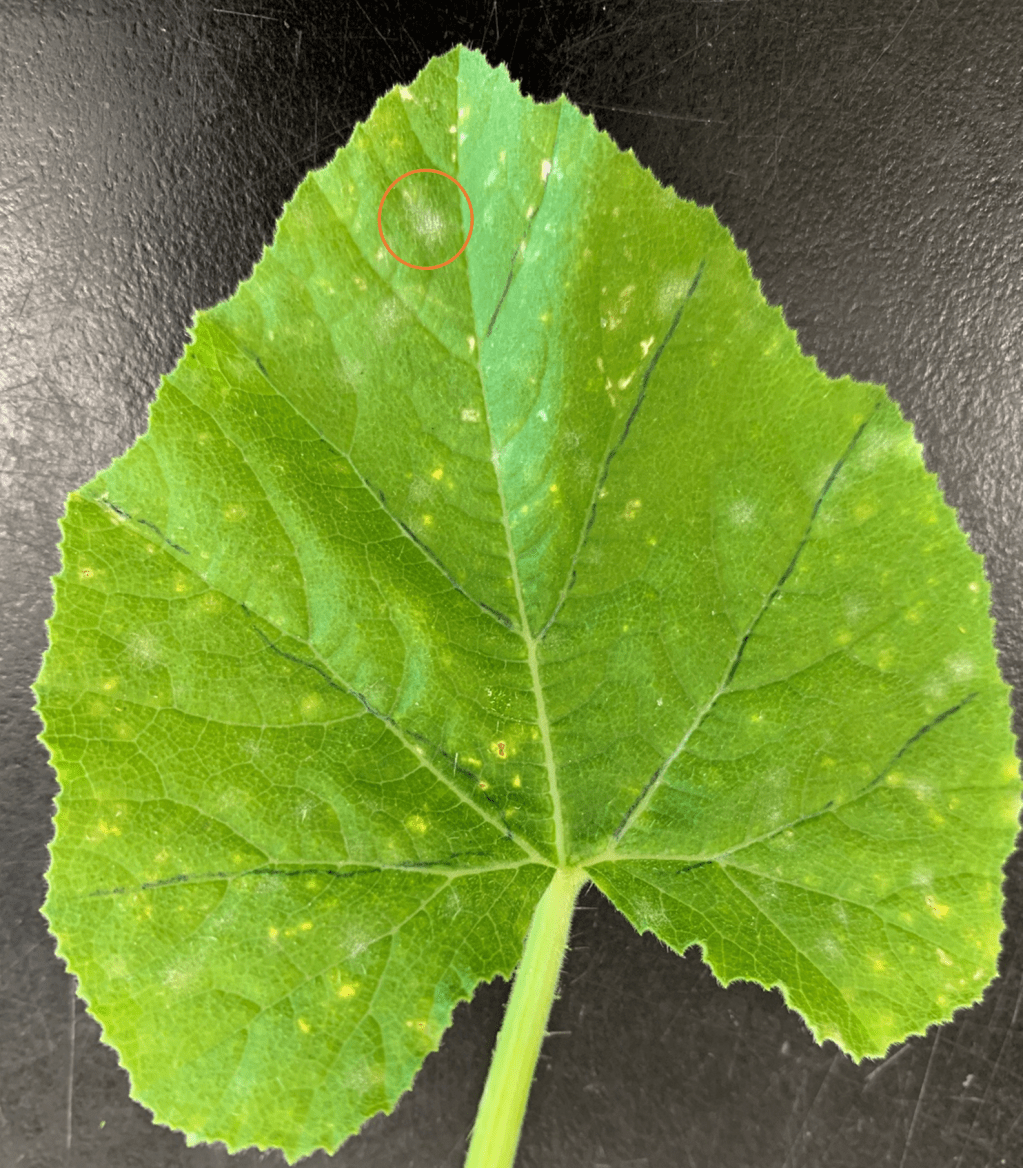
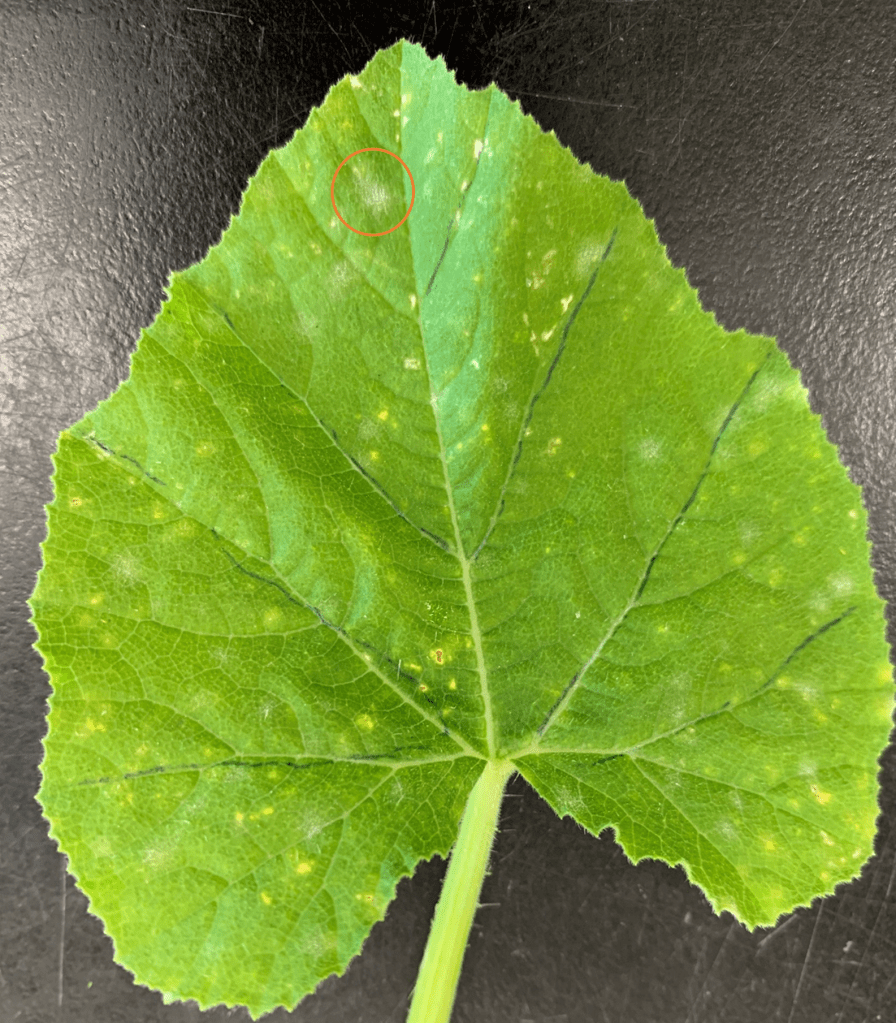
Full disclosure: One of my reasons to do this bioassay was the severe powdery mildew on ‘Butterscotch’ butternut squash, a productive cultivar that produces a lot of smaller, 1- to 2-pound fruit. The butternut squash was part of a downy mildew fungicide scheduling experiment. Apparently, we did not start spraying for powdery mildew soon enough. Sprays for powdery mildew should begin either when the first colonies are seen on the crop or when powdery mildew is known to be active in the area. The scouting threshold for powdery mildew is 1 colony (see photo above) on 1 leaf of 50 older leaves checked, either on the top or on the bottom of the leaf. (Note, not 1 colony on each leaf!)
The threshold works for spring crops, but the outbreak of powdery mildew in my downy mildew experiment reminded me that in the fall, susceptible crops, particularly pumpkins and squashes, should be sprayed preventatively for powdery mildew, that is, before spots are seen.
 The South Carolina Grower