From Clemson Plant Pathologist Tony Keinath
Sclerotinia white mold, a cool-season disease on several different vegetable crops, is present on collard and (probably) on kale. It is particularly common on over-wintered crops.

The white mold fungus has a complex life cycle. The fungus, Sclerotinia sclerotiorum, survives long-term and over the summer as sclerotia in soil.
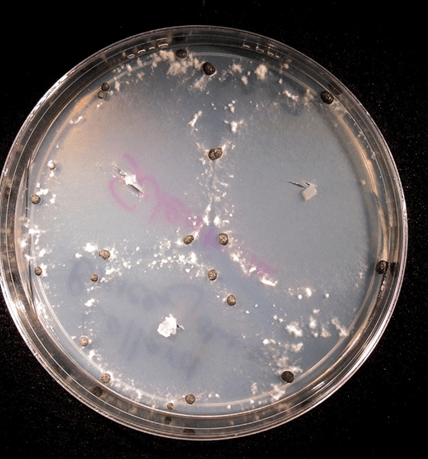
Sclerotinia infects plants in two different ways. Sclerotia can germinate like a seed, and then the fungus grows a short distance (an inch or two) to a nearby plant and attacks the stem. More likely, freezing temperatures trigger sclerotia to produce tiny mushrooms that produce airborne spores. Traveling spores are why white mold can show up in fields with no history of the disease.
Using conventional fungicides to manage white mold is difficult, because of the limited number of applications that can be made. Fontelis (FRAC 7), the best fungicide, may be applied only twice per crop. Two applications 14 days apart will protect the crop for 1 month, but white mold may still show up after that. Probably the best use of these two applications is within the 4 weeks before harvest, since older brassicas seem to be more susceptible than younger plants.
Note that the other common FRAC 7 fungicide, Endura, has a 14-day PHI on leafy brassicas, while Fontelis has a 0-day PHI. However, use either Endura or Fontelis, but not both on the same crop, because they are both FRAC 7 fungicides.
Lalstop Contans is an organic-approved, soil-applied biofungicide that is effective against white mold. This water-dispersible granule is applied by spraying it over the bed surface before laying mulch or over bare soil before seeding or transplanting. It also can be applied to crop residue at the end of the season to reduce the number of sclerotia that form. Note that Contans works best at the temperatures that promote growth of the active ingredient, a beneficial fungus that prefers soil temperatures between 50 and 81 F. Fortunately, these temperatures are within the range at which Sclerotinia also is active.
Contans may not be in stock at your local pesticide dealership. I verified that it is currently available from SipcamAgro in Durham, NC. It can also be purchased online at https://progressivegrower.com/product/contans-25-lbs/.
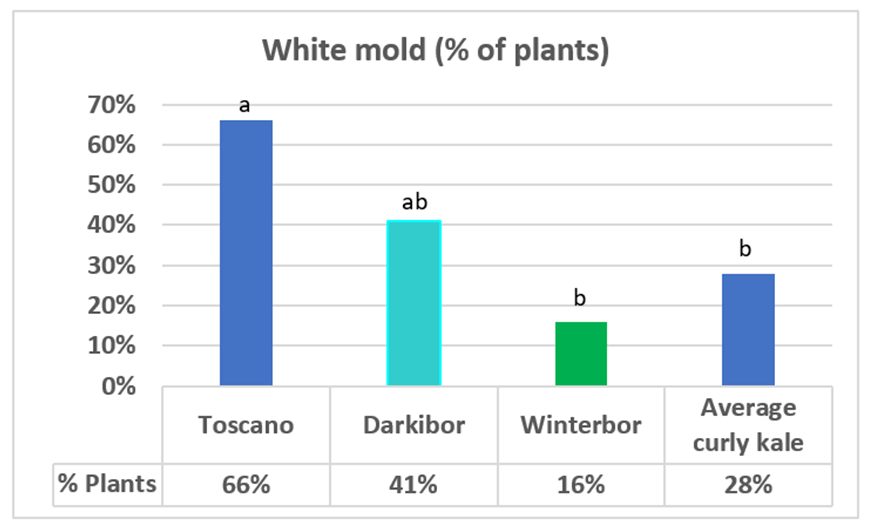
The best rotation crops to manage white mold are grains and grasses, including sweet corn but not onions, because they are not hosts for Sclerotinia. Another very susceptible vegetable crop is snap bean, which should not be grown in rotation—ever—with head and stem brassicas, particularly broccoli, cabbage, collards, and kale. White mold also can affect carrots, parsley, and the stems of tomato plants in cool springs. Because lacinato kale is more susceptible to white mold than curly kale, it is not recommended for overwintering.
For more information about white mold, see my December 2023 article in American Vegetable Grower or a previous gardening column in The Post and Courier.
 The South Carolina Grower