By Guido Schnabel, Jeffrey A. Hopkins, and Johanna Wesche
Recently, the article Fungus-Based Biological Control Agents: How Useful Are They for Strawberry Disease Management? was published. The article reported our first experience with yeast-based biological control agents (BCA) against Botrytis fruit rot (BFR) and Anthracnose fruit rot (AFR) of strawberry. The trials were conducted at the Clemson University Musser Fruit Research Center (MFRC) with encouragement and assistance of the South Carolina Small Fruit Grower Association. While the yeasts did not perform as hoped, there were a few takeaways worth mentioning: (1) the grower standard Switch 62.5WG worked against BFR and AFR; (2) the half rate of Switch worked just as well as the full rate of Switch against BFR and AFR; (3) Botector and Julietta had no efficacy; and (4) combinations of Switch with Botector or Julietta yielded no synergistic effects.
This article reports about the use of bacteria-based BCAs. Pseudomonas chlororaphis (Howler EVO) alone and in combination with the half and the full rate of DMI fungicide Propi-Star EC (propiconazole) were examined for strawberry disease management. Why the combination? In controlled lab studies and in field studies on peaches, the combination of Howler EVO with low dose rates of Propi-Star EC showed synergistic effects equal to the full rate of Propi-Star EC. But why propiconazole? It is a powdery mildew fungicide and typically not recommended for BFR or AFR control. We are looking at boosting DMI fungicide performance with biopesticides because we are running out of FRAC codes to rotate in Integrated Pest Management (IPM) programs due to resistance development.
The plasticulture field trial (Fig. 1 left) was a complete randomized design with four replicate plots per treatment, and each plot contained 20 Albion plants (a total of 80 plants per treatment). Plots were separated in-row by 8 ft of buffer plants. All treatments were applied with 100 gallons of water per acre before predicted infection events (based on weather forecasts predicting significant rainfall at temperatures suitable for infection). The treatments were applied at 150 psi with a shielded 5-nozzle half-circle-shaped boom sprayer built to provide turbulent air movement to increase treatment penetration and eliminate spray drift between plots. We collected data twice a week during April and May.
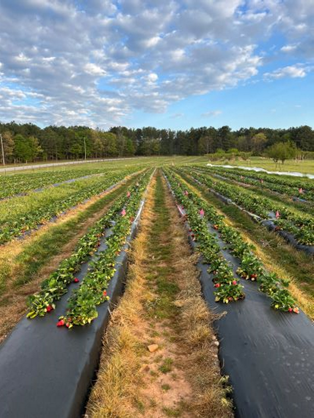
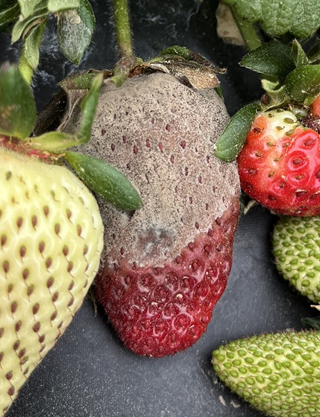
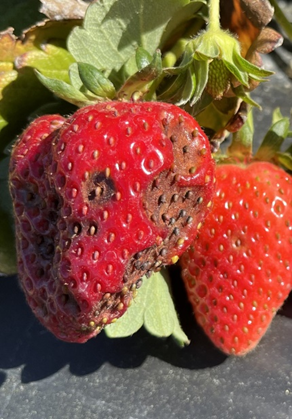
Fig. 1. Images of the field plot at Musser Farm (left), Botrytis fruit rot (BFR; middle), and Anthracnose fruit rot (AFR: right).
The field trial was ‘a success’ from a research perspective because the diseases BFR and AFR was present (Fig. 1 middle and right). No evidence of phytotoxicity (such as potential stunting caused by propiconazole) was observed in any of the treatments. None of the experimental treatments provided BFR suppression, not even the grower standard (Switch 62.5 EC rotated with Merivon + Captan; Fig. 2). What happened?
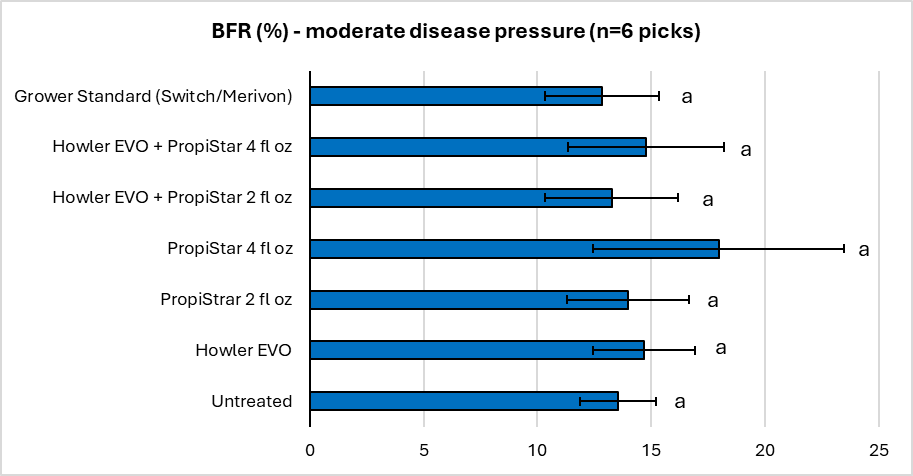
The results were like another trial I (Schnabel) was involved in, that was conducted recently on the west coast. The authors speculated that the wind moved around the Botrytis spores so effectively that any treatment effects were erased. That may have happened to us in Clemson as well. Another possible explanation for the grower standard failure was that the pathogen causing BFR (Botrytis cinerea) may have been resistant to Switch and Merivon. Resistance to Merivon is common and it was determined that isolates from the grower standard treatment were indeed resistant to fludioxonil (the main active ingredient in Switch). Based on these variables, we CANNOT conclude that Howler EVO alone or in combination with Propi-Star EC had no effect on BFR (although the data looked that way). Regarding AFR, we were luckier. During low (data not shown) and high disease pressure situations, we saw a clear effect of the grower standard against this disease (Fig. 3).

In contrast to B. cinerea, spores of Colletotrichum nymphaeae (the causal agent of AFR) do not travel far; they are only dispersed by rain splash. In other words, effects of small plot treatments do not carry over easily to other larger plots. Also, resistance to Switch has not been reported. The suppression of disease in the grower standard meant that we had a good experiment. However, it also meant that none of our experimental treatments (including Howler EVO) had any effect against AFR disease. Even the mixture of Howler EVO plus the high rate of Propi-Star EC failed. While this was disappointing, it still is useful information for growers. As of 2024, the label of Howler EVO claimed efficacy against AFR of strawberry caused by Colletotrichum spp. But there clearly was none. The Federal Insecticide, Fungicide, and Rodenticide Act (FIFRA) requires that EPA evaluate the proposed pesticide to assure that its use will not pose unreasonable risks of harm to human health and the environment. To the best of my (Schnabel) knowledge, efficacy data are generally not required to support the EPA registration of biopesticides in the USA. As such, field efficacy trials like this one are particularly important for growers.
In conclusion, small plot trials to investigate efficacy of fungicides against strawberry diseases appear useful for some but not all diseases. Meaningful efficacy trials against BFR, for example, appear to be most problematic. None of our test products or product mixtures worked against AFR, but they may still be useful for other strawberry diseases. We will keep looking…
 The South Carolina Grower