From Clemson Plant Pathologist Tony Keinath and Extension Associate Justin Ballew
The freezing weather the week of January 21, 2025, was just what the Sclerotinia white mold fungus was waiting for. While cold temperatures discourage most animals from being active, freezing temperatures trigger Sclerotinia sclerotia (the survival structures in soil) to germinate, produce tiny mushrooms, and release airborne spores. Traveling spores are why white mold can show up in fields with and without a history of the disease.
To track these spores, we borrowed a technique used to track cucurbit downy mildew since 2008, sentinel plots of a susceptible crop scouted weekly and not sprayed. Sentinel plots function as an early warning system. a bit like trap crops for insects. Based on results of a trial at Coastal REC in winter 2022, we selected ‘Toscano’ Tuscan kale and ‘Winterbor’ curly kale as host crops. White mold sentinel plots were planted at Coastal REC, Charleston, and in a grower’s field in Lexington County in mid-October 2024.
In addition to kale, we added ‘Glory Rose’ stock (Matthiola incana), based on observations from my (Tony’s) yard that stock is susceptible to white mold. That’s not too surprising, since stock is a brassica, like kale and related crops. Sclerotinia is also known to like dead flowers and petals.

Last week, the white mold sentinel plots showed that the Sclerotinia fungus is active, and the weather is right for disease to start. In Charleston, we found the first stock plant with symptoms on Feb. 6. At the base of the stem was a brown lesion with tufts of (literally) white mold that will turn into black sclerotia. By Monday, Feb. 10, all six plots with stock had one or more plants with bleached flower stalks and tufts of white mold. No kale had symptoms.
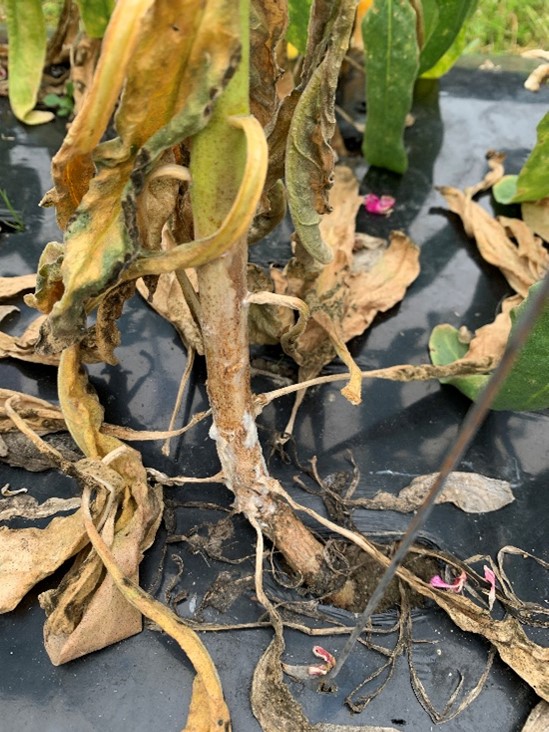

White mold on stock. Left: White mold lesion at the base of the stem. Right: white mold on the flower stalk. Two sclerotia are visible just below the flowers.
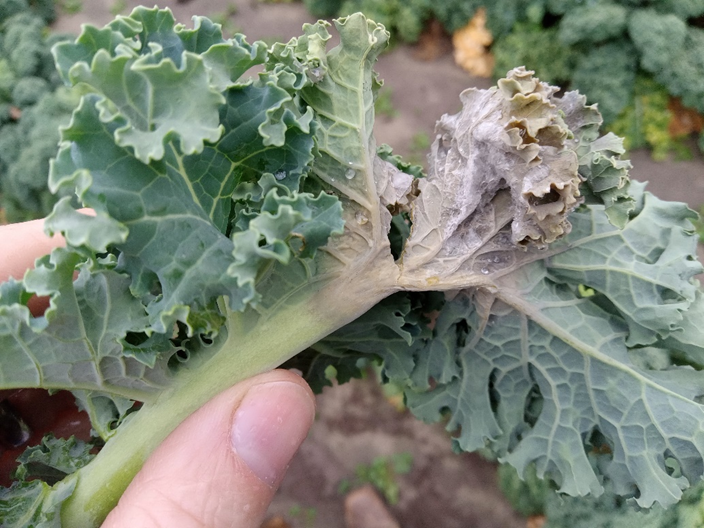
On Feb. 11, one ‘Winterbor’ plant in Lexington had a large, soft, grayish area on the edge of a leaf with a thin layer of white mold and a few small tufts. Again, the tufts of white mold are a key to identifying this fungus and disease in the field. Based on this initial trial, it looks like sentinel plots of stock and kale could be useful to detect white mold and serve as a signal for when it’s time to spray a fungicide in conventional production.
Using conventional fungicides to manage white mold is difficult, because the number of applications is limited. Fontelis and Endura, both FRAC 7, are the most effective fungicides against white mold. Only two applications total are allowed per crop, that is, two applications counted across all FRAC 7 fungicides. The small number of sprays allowed is why we decided to try sentinel plots to time fungicide sprays when the risk of white mold is high. So, yes, it’s time to spray, and we recommend two applications of a FRAC 7 fungicide to conventional kale and collard, one this week and the next application 2 weeks later. Note that Endura has a 14-day PHI on leafy brassicas, while Fontelis has a 0-day PHI.
Organic control of white mold involves prevention by using Lalstop Contans, an organic-approved, soil-applied biofungicide. Spray it over the bed surface before laying mulch or over bare soil before seeding or transplanting. It also can be applied to crop residue at the end of the season to reduce the number of sclerotia that form. Note that Contans works best between 50 and 81 F, the temperatures that promote growth of the active ingredient, a beneficial fungus, that attacks sclerotia.
Contans may not be in stock at your local pesticide dealership. I verified that it is currently available from SipcamAgro in Durham, NC. It can also be purchased online at here.
Besides kale, overwintered parsley and carrots also should be treated for white mold. Both Fontelis and Endura may be applied to these susceptible crops. Note that white mold has not been reported on cilantro, but if you see it, please let us know.
 The South Carolina Grower
One response to “White Mold is Active so Spray Now”
[…] These leaves are infected with Sclerotinia sclerotiorum, the causal fungus of white mold. White mold is showing up in brassica fields now in South Carolina. Initial development is initiated when cold weather triggers sclerotia (hard, black survival structures found in the soil) to produce tiny mushrooms that release spores. The spores infect collards, kale, cabbage, broccoli, etc. and develop leaf spots with grey discoloration and white fungal growth, like the one in the photo. These lesions may also develop on developing cabbage and broccoli heads. The stems may be attacked as well, which may lead to the death of the plant. Plant Pathologist Tony Keinath wrote a recent article with some management tips that can be found he… […]
LikeLike