From Clemson Plant Pathologist Tony Keinath
I am part of an exciting collaboration with Dr. Michael Mazourek from Clemson University to help him complete the breeding and selection process for a new pickling cucumber with high levels of resistance to downy mildew. Field work at the Clemson Coastal REC in Charleston started last fall. We planted 6 advanced lines and 4 check cultivars: DMR NY-401, a resistant slicing cucumber from Michael’s program, and 3 susceptible cultivars, Eureka and Gershwin pickling and Marketmore76 slicing cucumbers.
A short timeline of the experiment:
- Aug. 31: Transplanted cucumbers.
- Oct. 3: Noticed some stand loss. Confirmed it was due to Pythium root and stem rot. Yields will have to be calculated per plant to account for different numbers of plants per plot.
- Oct. 10: First downy mildew rating. Downy mildew probably showed up 7 to 10 days earlier, since some plots already had 15% of the leaves diseased.
- Oct. 14: First harvest. Fruit were graded by size (diameter) and shape on the following scale: <1.25 inches diameter, 1.25-1.75 inches diameter, >1.75 inches diameter (oversize, typically on Monday harvests), crooks, and nubs.
- Nov. 8: 13th and last harvest (whew!).
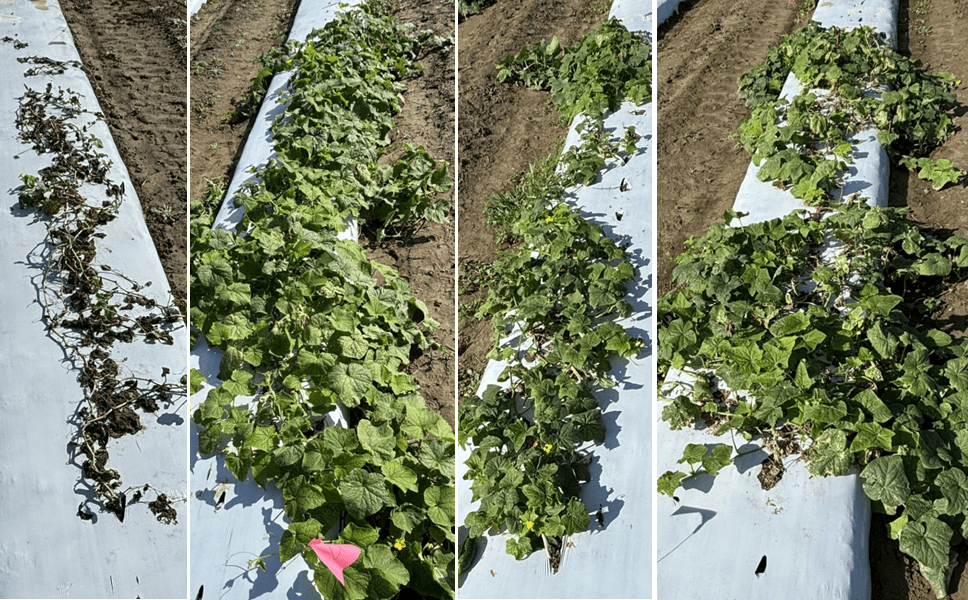
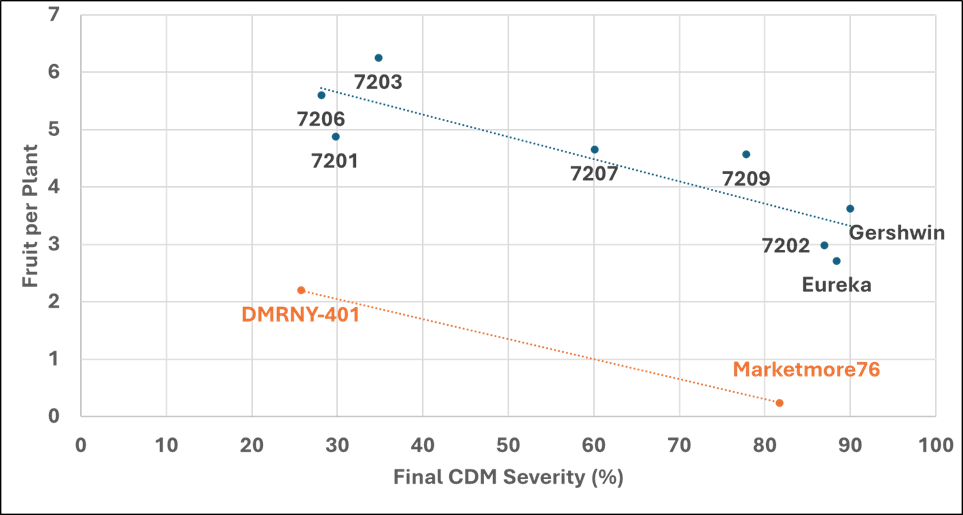
Disease and yield results are summarized in the graph below. Three lines, 7201, 7206, and 7203, had resistance equal to resistance in DMR NY-401 and produced significantly more fruit per plant (5-6 compared to 2 for DMR NY-401). The three susceptible check cultivars had severe downy mildew (>80% of the foliage diseased). Thus, the two objectives of this project were achieved in the initial SC test: find a line or lines of a pickling cucumber with i) resistance as good as DMR NY-401 and ii) with better yield.
The graph also shows a direct relationship between severity of downy mildew and number of fruit: lines with less downy mildew produced more cucumbers. This trend was seen with both pickling and slicing cultivars and lines.
This trial was also done in Ithaca, NY, summer 2024. It is being repeated in both locations in late spring 2025 to check yields under warmer conditions. After that, one line will be selected for seed production. Stay tuned for a chance to suggest and vote on a name for the new cucumber. Dr. Lane Selman, Oregon State, will be leading the marketing campaign.
 The South Carolina Grower