From Tom Bilbo, Extension Entomologist
As the weather warms up and our summer vegetable crops get going, it’s time to be on the lookout for cucumber beetles in our various cucurbit crops.
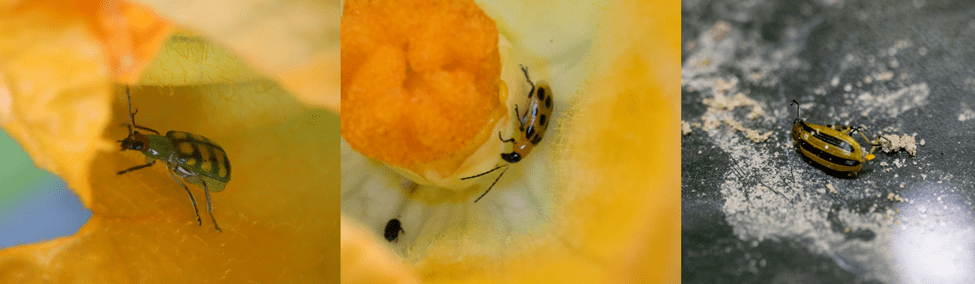
There are three species that we see in South Carolina: banded, spotted, and striped cucumber beetles, with the latter two being more problematic as pests in SC. The striped cucumber beetle has a lookalike in the western corn rootworm, which is not a cucurbit pest, so be sure to know which one you are dealing with. Banded and spotted cucumber beetles are polyphagous and can be found on a wide range of plants. Striped cucumber beetles are cucurbit specialists.

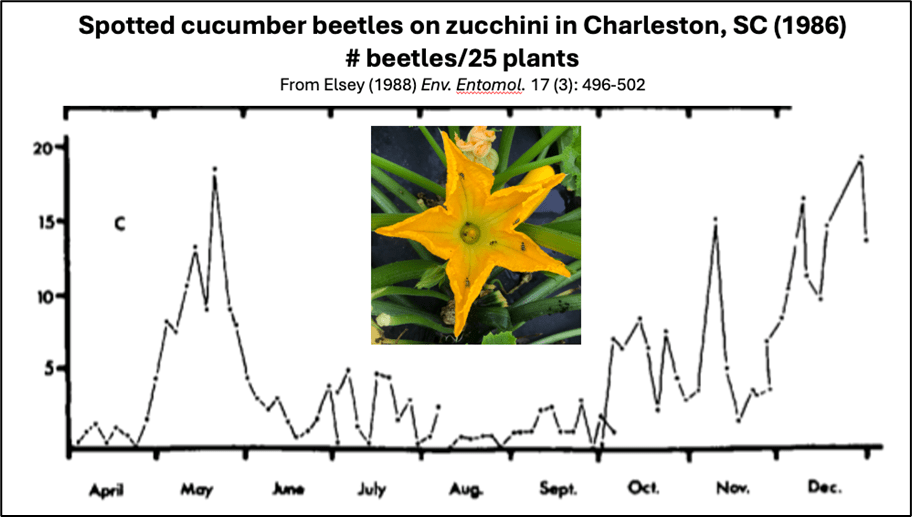
These beetles overwinter as adults in or around a previous year’s cucurbit crop. As the weather warms in the spring, they’ll emerge and move into cucurbit fields. The figure below shows a very distinct influx period of spotted cucumber beetles into zucchini. In Charleston, SC this usually happens in May. Adult females will lay eggs around the base of plants and the grub-like immatures will feed underground on roots, stem bases, and even fruit rinds that are in contact with the soil.
Management
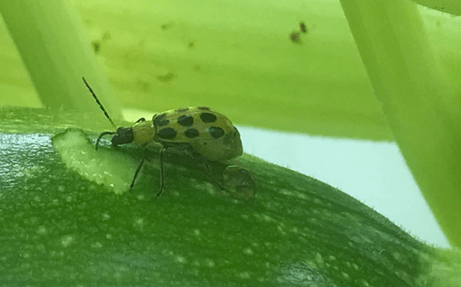
Cucumber beetles are primarily a pest as adults. They feed on cotyledons, foliage, stems, and even fruit. Importantly, they can transmit the bacterium that causes the disease bacterial wilt. If your fields have a history of bacterial wilt, then this will change your tolerance and management approach. Seedlings are highly sensitive to feeding damage and should be protected, while the vigorously growing vegetative stage can tolerate quite a bit of feeding before seeing yield loss. For example, a treatment threshold of 60% leaf area damage (over the entire field) was developed for pumpkins (Hoffman et al. 2003), and a 50% leaf damage threshold for winter squash (Ayyappath et al. 2002). Cucurbit crops vary in their preference by beetles and tolerance to bacterial wilt. For example, cucumbers and cantaloupe are more susceptible to wilt, and melon rinds are susceptible to larval feeding, while buttercup squash (Cucurbita maxima) is preferred by beetles and tolerant of adult feeding, so it has been used as a trap crop to lure beetles away from butternut and other less attractive cucurbits (Haber et al. 2021).
There are a number of cultural control strategies that can be used to protect plants. Transplanting instead of direct seeding can limit the exposure of more susceptible smaller plants to beetles. Floating row covers can physically exclude beetles as another way to protect young plants, but must be removed when flowering begins as cucurbits depend on pollinators. Rotating cucurbit fields as far away as possible from the previous year may help delay the influx of beetles. Planting highly attractive cucurbits such as blue hubbard and buttercup squash at field perimeters may be able to lure beetles away from the cash crop (where they then must be killed). Note: this will likely not work if your cash crop is highly preferred, such as summer squash and zucchini. More details on cultural control strategies and important natural enemies can be found here.
Chemical insecticides may be necessary when cucurbits are commonly grown and beetle populations in a local area are high most years, as well as when bacterial wilt occurs in your fields. Only a few chemical classes are effective at managing cucumber beetles (see Table below) and unfortunately the best products (pyrethroids and neonicotinoids) are also harmful to natural enemies and pollinators. Stacking several cultural control tactics and only applying insecticides when beetles reach a treatment threshold for your crop can help conserve beneficial predators and pollinators. Insecticide treated seeds are commonly used and can be valuable for protecting seedlings, with a window of protection of ~2 weeks or sometimes longer. A recent study by Hung et al. (2025) investigated the interaction between seed treatments and cucurbit crops in the Midwest US. They found that concentrations of at-planting neonicotinoid insecticides remained much higher in flowers and foliage in cucumber than in pumpkin or watermelon. This was highly effective at suppressing beetles for the entire season, but with the tradeoff that potential exposure to pollinators was high in cucumber and low to moderate in pumpkin and watermelon. Organic insecticide options are limited. Pyrethrins may provide some suppression but must make direct contact with beetles, otherwise, they degrade too rapidly to be useful. Pyrethrins are also toxic to non-target insects. Spinosad has some toxicity and feeding deterrent properties. Kaolin clay may reduce attraction and feeding.
| Chemical class (IRAC) | Common name | Product | Efficacy |
| 1A | oxamyl | Vydate | F |
| 1B | malathion | Malathion | G |
| 3A | pyrethoids (various) | Brigade, Mustang Maxx, etc. | G to E |
| 4A | neonicotinoids (various) | Assail, Venom, etc. | G to E |
| 22A | indoxacarb | Avaunt eVo | F |
| 28 | cyantran- and cyclaniliprole | Exirel/Verimark, Harvanta | F to G |
“E” Excellent, “G” Good, “F” Fair. From 2025 Southeastern U.S. Vegetable Crop Handbook
References:
Ayyappath R, MP Hoffman, and J Gardner. 2002. Effect of striped cucumber beetle (Coleoptera: Chrysomelidae) foliar feeding on winter squash injury and yield. J. Entomol. Sci. 37: 236-243.
Haber AI, Wallingford AK, Grettenberger IM, Ramirez Bonilla JP, Vinchesi-Vahl AC, and Weber DC, Striped cucumber Beetle and Western Striped Cucumber Beetle (Coleoptera: Chrysomelidae), Journal of Integrated Pest Management 12:1 (2021).
Haber AI, Bekelja K, Huseth AS, Buntin GD, Musser F, Ramirez Bonilla JP, et al., Spotted cucumber beetle/southern corn rootworm: profile of a polyphagous native pest, Journal of Integrated Pest Management 14:18 (2023).
Hoffman, MP, R. Ayyappath, and J Gardner. 2003. Effect of striped cucumber beetle (Coleoptera: Chrysomelidae) foliar feeding on pumpkin yield. J. Entomol. Sci. 38: 439-448.
Hung K-LJ, Ternest JJ, Wood TJ, Ingwell LL, Bloom EH, Szendrei Z, et al., Plant versus pollinator protection: balancing pest management against floral contamination for insecticide use in Midwestern US cucurbits, Journal of Economic Entomology 118:262–273 (2025).
Snyder WE. 2012. Managing cucumber beetles in organic farming systems. eOrganic.org, https://eorganic.org/node/5307
 The South Carolina Grower