From Clemson Plant Pathologist Tony Keinath
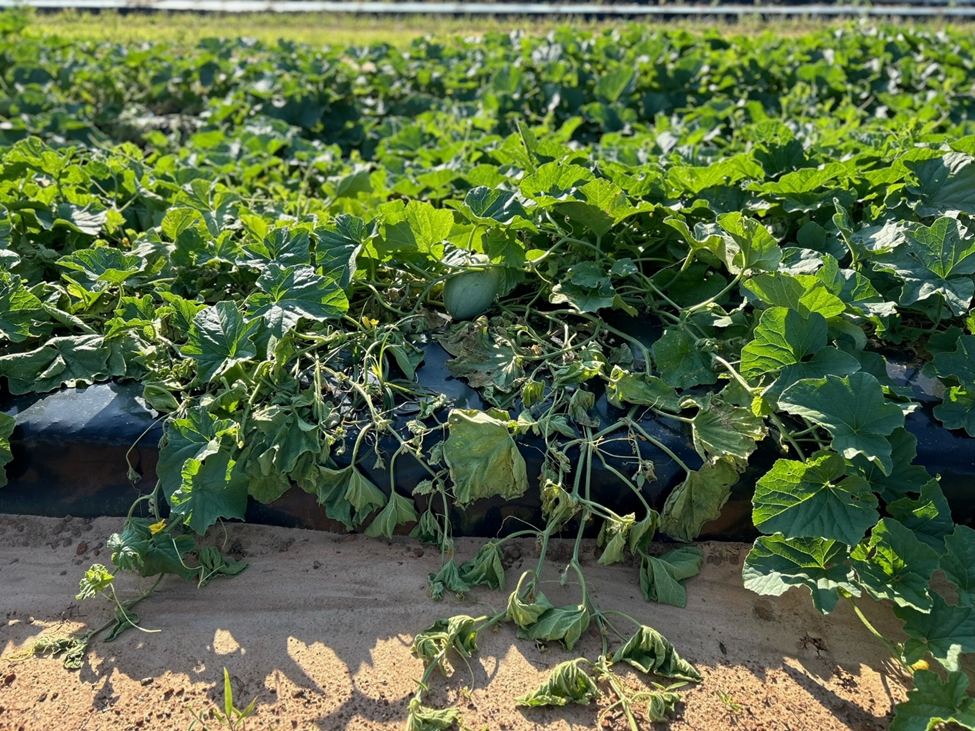
After a very dry April, the heavy rains in May triggered a case of Pythium root rot in one cantaloupe field in South Carolina in the past 2 weeks. Another name for Pythium root rot on mature cucurbits is “sudden wilt” to distinguish it from the more common damping-off and root and stem rot caused by Pythium on younger cucurbit plants. One of the Pythium species that causes sudden wilt also affects peppers and tomatoes and causes cottony leak, a fruit rot on cucurbits.
Note that the information in this blog applies only to cantaloupe. Samples of watermelon plants “going down” are still being diagnosed.
Symptoms and Diagnosis of Sudden Wilt
Usually, the first symptoms of sudden wilt are those seen above ground, when cantaloupe with maturing fruit suddenly collapse or wilt. These noticeable symptoms, however, are not the “first” symptoms to appear. With most annual plants, wilting points to a root problem.
To reliably diagnose Pythium root rot on cucurbits and other vegetables in the field, look for soft, brown or tan roots. The diagnostic symptom is a sloughing of the root cortex, the outer thick layer of the root. The cortex may be removed when the root system is dug from the ground or by rubbing the root. The thin portion left is the central vascular cylinder, the water- and food-conducting tissue of the root. In small roots, this portion is so thin the sloughing of the cortex is called “shoe-stringing.”
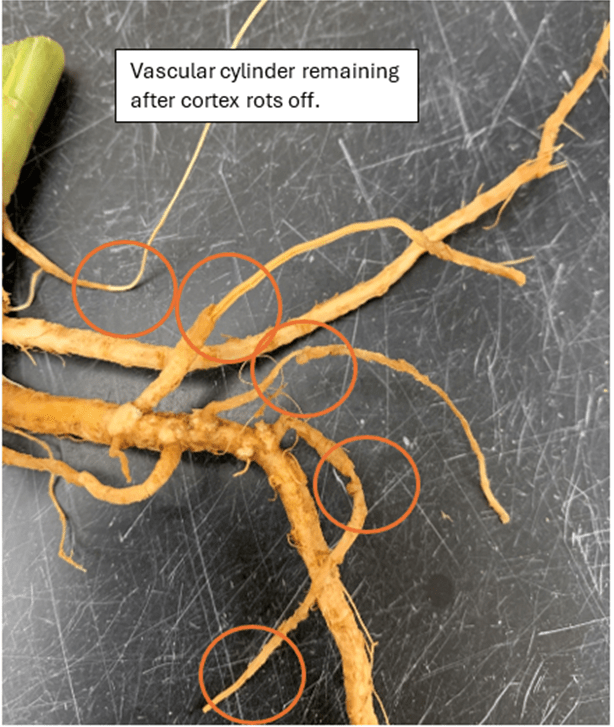
Note that these important diagnostic symptoms can only be seen if the plant is dug, not if it is pulled. Digging keeps some of the soft, rotted roots attached to the plant. Attempting to pull a plant with root rot will ensure that the rotted roots remain in the ground, which will complicate the diagnosis.
Pythium, the Cause of Sudden Wilt
Pythium is the most common water mold (or oomycete) in soils in the southeastern USA. This pathogen survives as oospores with a relatively thick wall that protects them from heat, cold, and drought. So why are we seeing Pythium root rot now?
The combination of a long dry period followed by heavy rains is ideal to rouse Pythium oospores from dormancy (long-term sleep). Dr. Steve Jeffers, ornamental and tree pathologist at Clemson, a worldwide expert on oomycetes, confirmed that the dry period “wakes them up.”
- In the early stages of a rainstorm, oospores germinate and form sporangia (the basic spore type of oomycetes) in moist, but not yet saturated soil.
- As more rain falls, the sporangia release zoospores, or swimming spores, in saturated soil.
- Zoospores can sense sugars and amino acids leaking from roots. Like pheromones attracting insects, the zoospores swim to the roots and infect through the root hairs.
This entire process happens unnoticed underground.
As Pythium spreads through the root system, roots begin to rot, and uptake of water is reduced, leading to wilting. Other above-ground symptoms may include yellow older leaves and stunted plants. However, sudden wilt cannot be reliably diagnosed based on above-ground symptoms, especially yellowing.
Management of Sudden Wilt
Whether and how much more sudden wilt will develop depends almost entirely on the weather. If rainfall is “normal,” which may not be likely given NOAA’s prediction for above-average rainfall for the next three months, no more plants may go down to sudden wilt. It’s hard to say whether a treatment in currently affected fields is warranted. If collapsed plants are in an obvious low spot, then the chances of spread or recurrence are greater than if diseased plants are not in a low spot.
Ridomil Gold applied through drip irrigation is the only management option once sudden wilt appears. Although the label suggests directed sprays are an alternative application method, this type of application will not work for two reasons.
- A dense canopy of vines will block the directed spray, and the fungicide will not reach the crown of the plant.
- An above ground spray, even a directed one, will not get enough the product into the soil and root system where Pythium is located.
Although the label lists 0.25 to 0.4 pint/acre for applications after transplanting (“subsequent applications” on the label), growers who did not apply Ridomil Gold at transplanting are allowed to use 1 pint/acre at this crop state. I recommend using this rate because of the size of the plants.
Growers do not need to take any special precautions moving implements from areas of the field affected with sudden wilt to other areas or fields. Pythium already is present throughout the field, farm, county, and state. Again, the reason sudden wilt develops is not that Pythium occurs only in the affected area, but that environmental conditions, the “third leg” of the disease triangle, promote growth of Pythium.
 The South Carolina Grower