Johanna Wesche and Guido Schnabel, Clemson University
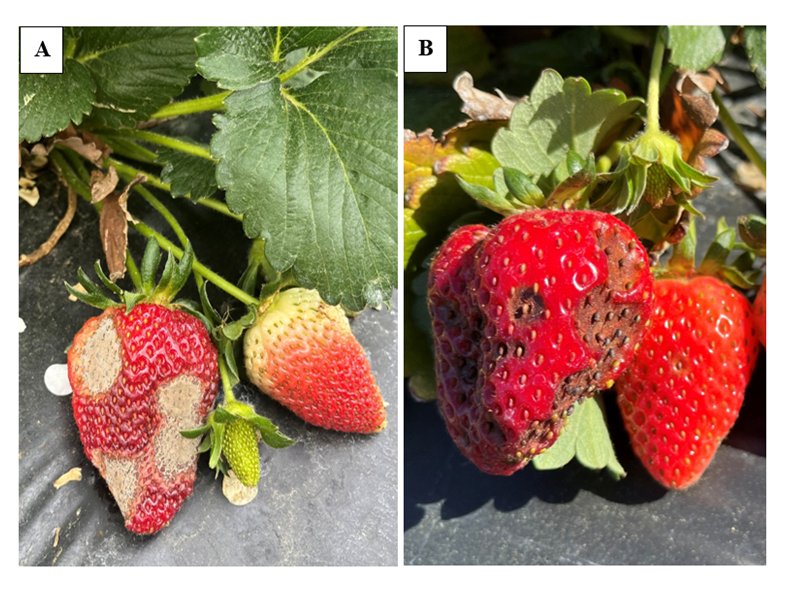
“Do biologicals work?” That is a frequently asked question coming not only from strawberry growers, especially in light of increasing resistance issues with many of the conventional fungicides and the fungicide insensitivity of Neopestalotiopis sp. In our recent article, “Biologicals Made Easy: Grouping and Understanding Biological Fungicides,” we introduced different groups of biological fungicides and their modes of action. We grouped them into biocontrol agents (BCAs), biorationals and botanicals, and basic substances. These products differ significantly in their formulation, activity, and dependency on environmental conditions. BCAs, for instance, contain living microorganisms that may suppress pathogens through direct antagonism, competition, or induction of plant defenses, while biorationals and botanicals do not form a biofilm and rely on fermentation products or plant extracts to directly inhibit pathogens. Basic substances, such as copper and sulfur, are long-established, broad-spectrum tools that are widely used in organic but also conventional farming. Understanding these distinctions is important when we try to use them effectively in organic production or try to integrate them into conventional spray programs. This article provides an overview of how these biological product groups have performed for the management of Botrytis fruit rot (Fig. 1A) and Anthracnose fruit rot (Fig. 1 B) in strawberries. There was not sufficient data available to do an analysis for Neopestalotiopsis disease.
How are these reports created? Extension specialists from California, Florida, and some other states with significant small fruit production conduct field trials, often in collaboration with industry, to evaluate conventional and biological products for strawberry disease management. Results of these trials are compiled in the Plant Disease Management Reports (PDMRs), a publicly available (for a fee) database managed by the American Phytopathological Society. We identified and analyzed PDMRs from 2007 to 2023, focusing on the performance of various non-conventional products against Botrytis fruit rot and Anthracnose fruit rot in strawberries.
Biological product groups were:
- Biocontrol Agents (BCA): products based on fungi, yeasts, or bacteria (e.g. Bacillus).
- Microbials: non-living bacterial metabolites.
- Botanicals: plant extracts and essential oils.
- Basic Substances: copper, sulfur, calcium products, and phosphites.
Only PDMRs were included with disease incidence in the untreated control greater than 5%. The disease incidence (%) for the untreated control, the grower standard, and the experimental treatments were used in this study. The efficacy of each treatment was calculated as follows: ((untreated control-treatment)/untreated control) *100. To calculate the relative disease incidence, this value was subtracted from 100. For example, if the untreated control had 45% disease incidence and your treatment had 10%, ((45-10)/45) *100 = 77.7% (is the relative fungicide efficacy). To calculate the relative disease incidence: 100-77.7 = 22.3%.
A total of 16 PDMRs were identified for Botrytis fruit rot using the 5% threshold level mentioned above. Seven reports from Florida, four from California, two from South Carolina, two from Michigan, and one from Virginia. For Anthracnose fruit rot, a total of 10 PDMRs were used. These included seven reports from Florida, one from South Carolina, one from California, and one from Michigan.
Results for Botrytis Fruit Rot. The analysis revealed that the average Botrytis fruit rot incidence in the grower standard treatments was around 36% (Fig. 2) and that none of the biological groups were as effective. Yeasts and basic substances often outperformed the other biologicals with medium Botrytis fruit rot incidences of 54% (yeasts) and 59% (basic substances). The larger the number of studies (n), the more confidence we can place in the analysis. If the number is low (e.g., n=4 on yeast products), the confidence we place in the data is also low. All other biologicals failed to provide satisfactory control, with an average disease incidence exceeding 70%.

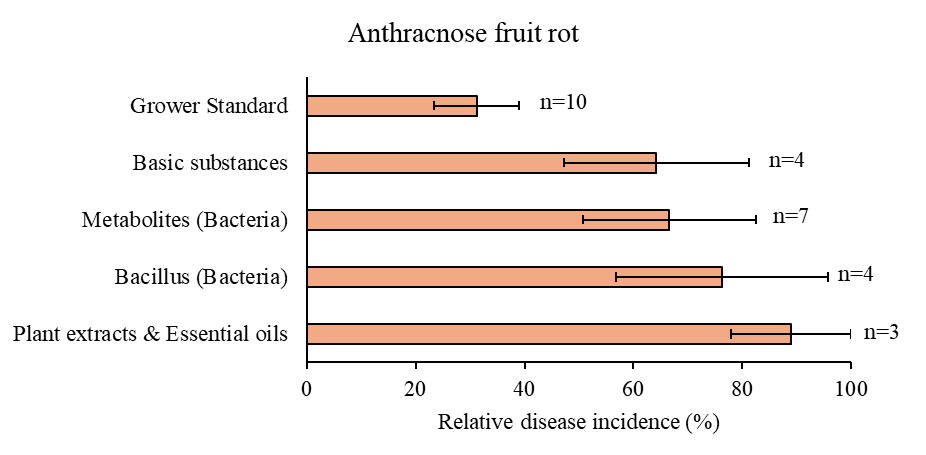
Results for Anthracnose Fruit Rot. For Anthracnose fruit rot, the grower standard treatments had an average disease incidence of 31% (Fig. 3). Botanicals and essential oils had very little efficacy towards this disease. But this data needs to be taken with a grain of salt, as these averages were derived from only three published reports (n=3). Basic substances, bacterial metabolites, and Bacillus-based products did not do that much better, with average disease incidences between 64% and 76%.
Conclusion and Outlook
This simple analysis of multi-year PDMRs showed that at least in the past, biologicals have not been competitive with synthetic fungicides against Botrytis fruit rot and Anthracnose fruit rot of strawberries. Most of the data were obtained from California and Florida, where environmental conditions are very different from South Carolina. Especially in California, disease pressure is lower than in South Carolina. Perhaps biologicals may have performed even worse if they had been tested more in our climate; but that is just a guess. Biologicals may still have a place in our spray programs, however. They may be used during periods of low disease pressure, mitigating some of the risks that come with conventional fungicides. They may also provide additional efficacy in tank mixtures, but much more research is needed to make any recommendations to date.
 The South Carolina Grower