From Clemson Plant Pathologist Tony Keinath
Gray leaf spot has been found in a home garden in Greenville County and on a farm in Charleston County, South Carolina. This disease is the most common foliar problem on heirloom tomatoes. ‘Cherokee Purple’ is particularly susceptible. The recent hot, humid, rainy weather is ideal for the gray leaf spot fungus.
Gray leaf spot is rarely found on hybrid tomatoes because almost all are resistant, although older cultivars of cherry and grape tomatoes may be susceptible. Resistance to gray leaf spot was one of the first success stories in breeding disease-resistant tomatoes by crossing domesticated tomato (Solanum lycopersicum) with a wild tomato species in the 1940s.
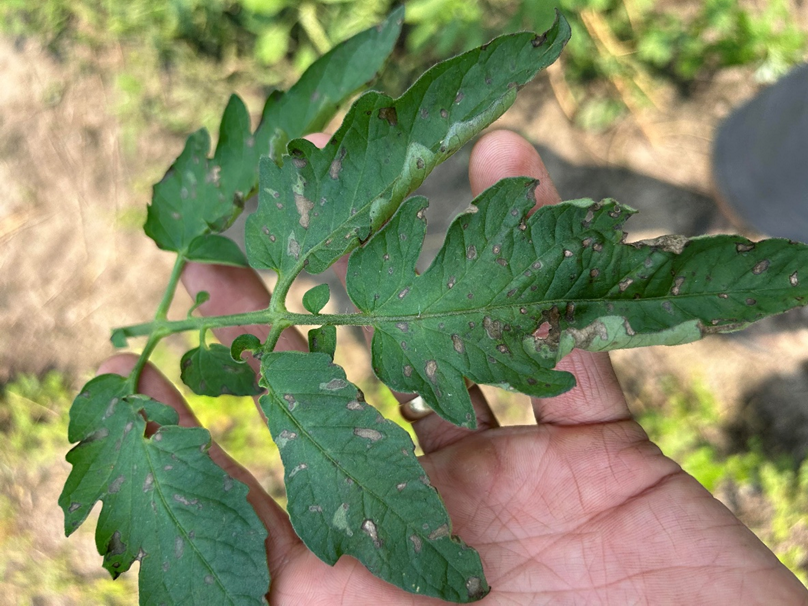
Diagnosing Gray Leaf Spot on Tomato
After checking the name of the tomato cultivar to verify it is susceptible, gray leaf spot is diagnosed by observing the number, color, size, and shape of leaf spots.
- Diseased leaves typically have A LOT of spots, up to 100 per leaf. The spots are relatively evenly spread over the entire leaf.
- The color is neither ash gray nor charcoal gray but sort of taupe gray. The surface of the spot is dull, not shiny.
- Leaf spots are relatively small, that is, larger than bacterial spot lesions but smaller than early blight lesions, about 1/8 to ¼ inch long.
- Leaf spots are round to irregular ovals, which is somewhat unusual for a fungal leaf spot, which tend to be round as the fungus grows out two directions from the spore that landed on the leaf.
The Cause of Gray Leaf Spot on Tomato
Stemphylium, the fungus that causes gray leaf spot, is related to and resembles Alternaria, but the dark spores are round, not elongated. According to current naming rules, five different Stemphylium species have been found on tomato. On leaves, the two common species are S. lycopersici and S. solani. The other three species were found on fruit in other countries, and fruit infection is supposedly rare in the United States. Despite some older reports in the literature, gray leaf spot affects only tomato in the field, not pepper, eggplant, or ground cherry.
Managing Gray Leaf Spot on Organic Tomatoes
Management for organic growers is difficult, as no biopesticides are effective. Grafting heirloom cultivars has no effect on gray leaf spot, because rootstocks mange root diseases, not leaf diseases. For future crops, orienting rows east to west (instead of north to south) will promote drying of the leaves and lessen (but not eliminate) the chance of infection.
Managing Gray Leaf Spot on Conventional Tomatoes Conventional growers can manage gray leaf spot with a typical tomato fungicide program; see Table 3-41 in the Southeastern 2025 Vegetable Crop Handbook. Growers who want to add a fungicide to their existing program specifically for gray leaf spot can use Priaxor or Switch, based on a trial from North Carolina State University.
 The South Carolina Grower