From Clemson Plant Pathologist Tony Keinath
Results from a June 2025 bioassay with powdery mildew on susceptible yellow summer squash ‘Early Prolific’ showed that, although all 8 fungicides reduced powdery mildew, 4 worked better than the rest.
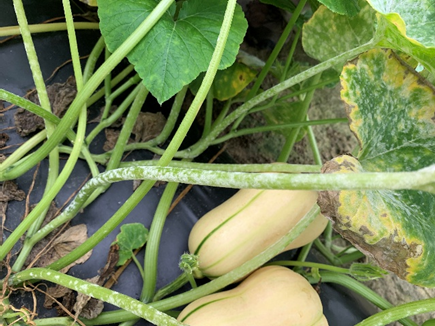
The Best Fungicides To Manage Powdery Mildew on Cucurbits
Torino, Quintec, Gatten, and Vivando completely suppressed powdery mildew on potted bioassay plants exposed for 48 hours to spores coming from nearby infected squash plants. Bravo, Procure at the low rate, sulfur, and Prolivo were less effective than the other 4 fungicides. These results are based on ratings of both the upper and lower leaf surfaces, since it’s critical to control powdery mildew on both leaf surfaces for effective management.
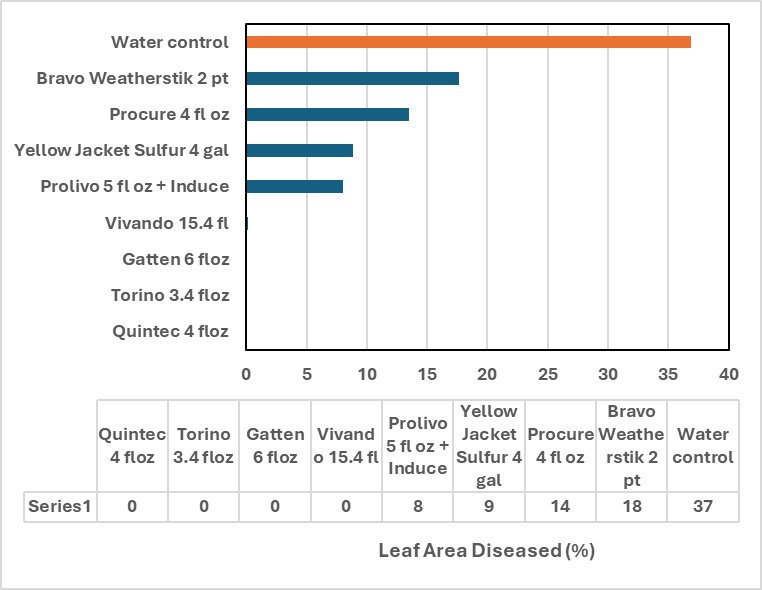
Note that Gatten, Bravo, and Procure were used at the lower labeled rate. The 6 fl oz rate of Gatten was completely effective. The low rate of Procure, however, was not as effective, so, if Procure is used, it must be used at the highest rate of 8 fl oz/acre.
Activity of fungicides to manage powdery mildew affects their effectiveness Fungicides interact with plants in different ways that are shown in Table 1.

Bravo and sulfur, an organic option, are contact fungicides that remain on the leaf surface. They did not control powdery mildew on the lower leaf surface (data not shown), which is one reason they ended up in the less effective group.
Quintec, Torino, and Vivando have vapor action. The active ingredient vaporizes after it lands on the leaf surface, so some of the active ingredient also contacts the lower leaf surface.
Gatten, Prolivo, Torino, and Vivando have penetrant activity, which means they move through the leaf. Penetrant activity is also called translaminar activity; “translaminar” means “across (or through) the leaf.” This type of activity is very important for managing powdery mildew, which occurs on both sides of the leaves.
Procure and Vivando are systemic fungicides, which means they move through the plant to kill powdery mildew inside the leaf. Presumably, they also move inside sprayed fruit, although powdery mildew does not infect squash fruit.
Five of the fungicides have some curative activity. These fungicides can kill powdery mildew for a short time (about 24 hours) after the fungus has infected the leaf. Curative activity, however, does not mean growers should wait to spray for powdery mildew. Delaying fungicide applications is very risky, and often means the disease will “get away from you” and be difficult to control by mid-way through the season.
Fungicides and cucurbit fruits
Consumers may be concerned about residues from systemic pesticides on produce. When the EPA sets Pre-Harvest Intervals (PHI) for pesticides, they account for residues both on plants from contact fungicides and in plants from systemic fungicides. The PHI is set as the day to safely harvest the crop when residues are below potentially harmful levels. One reason the PHIs for powdery mildew fungicides are low is that all of the fungicides tested, except sulfur and Bravo, are specific to powdery mildew (Table 1). These fungicides are not toxic to other fungi, other pathogens, plants, or humans.
Presumably, penetrant fungicides also move a short distance into the fruit. I could not find any information about how far into the fruit they move, but it is approximately the thickness of a leaf, so possibly just under the peel. Penetrant fungicides, however, do not reach the edible portions of watermelon, cantaloupe, or winter squashes.
As long as the PHI is observed, systemic and penetrant pesticides do not present a greater risk of exposure to fungicide residues than contact pesticides do. Growers can use the table of fungicide activities to choose fungicides that are not systemic if they or their customers do not like this type of fungicide.
Powdery mildew-resistant cultivars and fungicides
Some cultivars of summer and winter squash and pumpkins have intermediate resistance (IR) to powdery mildew. Look for “Px” in the list of resistances. This level of resistance is usually enough for early spring plantings, but late spring and fall plantings of IR squash still need to be sprayed. A 10-day schedule is probably sufficient. Susceptible cultivars of pumpkins, however, must be sprayed weekly.
Summary
In this bioassay, the most effective fungicides were those with vapor, penetrant, or curative activities. Although resistance to Quintec and Torino has been found in the northeastern and mid-Atlantic USA, the powdery mildew present in Charleston at the end of the 2025 spring season was completely sensitive to these fungicides. For the remainder of the year, conventional growers should choose three of the four most effective fungicides and rotate them.
As a reminder, do not use Prolivo and Vivando on the same crop, since they both belong to FRAC Code 50. Prolivo must be mixed with an adjuvant for maximum efficacy.
 The South Carolina Grower
2 responses to “2025 Recommendations to Manage Powdery Mildew on Cucurbits”
I’d be interested to see potassium bicarbonate tested. I’ve heard this works best on PM in the organic field.
LikeLike
Hi Jessica, Dr. Keinath has tried potassium bicarbonate and believes sulfur and Organocide to be better materials for powdery mildew. However, potassium bicarbonate is better than no treatment at all.
LikeLike