From Clemson Plant Pathologist Tony Keinath
Extension agents have recently received some questions from growers about reusing plastic from a spring watermelon crop for a fall watermelon crop. This scenario is what I call a classic plant pathology “horror story.” It is literally the worst thing a watermelon, cantaloupe, or cucumber grower could do for a fall crop.
The only cucurbit that can be planted safely after watermelon is summer squash, either yellow or zucchini. The best scenario is to reuse watermelon plastic for a non-cucurbit vegetable crop. Even in this case, the soil should be treated for nematodes with a nematicide listed in Table 3-42 of the 2025 Southeastern U.S. Vegetable Crop Handbook applied via drip irrigation before transplanting the fall crop.
The Risk of Gummy Stem Blight without Crop Rotation
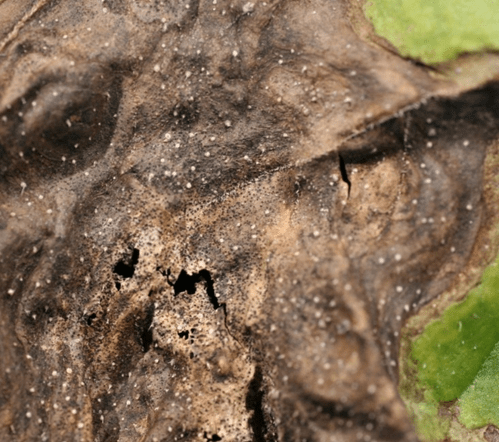
Based on my previous research, the gummy stem blight fungus survives 7 months in infested watermelon vines and at least 2 years in infested cantaloupe crowns. So, it is not safe to replant watermelon, cantaloupe, or cucumber immediately after a previous watermelon crop on the same plastic. Survival times are less when infested debris is plowed under.
Follow-up research showed that airborne spores spread at least 1200 feet from infested watermelon vine debris left on the ground. In the study, debris was left from a fall crop, and the spores were trapped the following spring.
The following data are from a commercial watermelon field in the Lowcountry. Although the grower had been on a good 2-year rotation away from cucurbits, he “messed up” by replanting watermelon back-to-back.
2014: corn
2015: soybean
Spring 2016: watermelon. 39% of diseased leaves had gummy stem blight
Fall 2016: watermelon. 100% of diseased leaves had gummy stem blight
The Risk of Anthracnose without Crop Rotation
Two growers could not control anthracnose on watermelons in spring 2013. Why?
Grower 1 reused watermelon plastic in 2013 from spring 2012.
Grower 2 planted into a field that had no rotation from watermelon. Anthracnose started in this field and then spread to the neighboring field that had been rotated away from watermelon. A recent study from the University of Florida found that spores of the anthracnose fungus spread both by rain and by wind (without rain), at least 50 feet.
Conclusion Everyone is trying to cut costs. Reusing plastic mulch and drip tape makes sense and is environmentally responsible…as long as reusing them does not create favorable conditions for disease to develop, which could increase the cost of fungicide applications. Even in a properly rotated field (2 years out of all cucurbits), fall watermelons need a rigorous, weekly, season-long spray program to make a profitable yield.
 The South Carolina Grower