By Guido Schnabel, Clemson University; Phil Brannen, University of Georgia; Bill Cline and Caleb Bollenbacher, North Carolina State University
Whether or not Neopestalotiopsis (Neopest) will harm your strawberries this season depends on many factors – including the quality of the transplants, the cultivar, sanitation practices, soil inoculum levels, weather conditions, and the fungicides you use. Below, we discuss aggressive chemical options for fields with recent Neopest infestations, or if transplants arrive with symptoms. In fields that have not had Neopest problems in the last two years and were planted with symptom-free plants (and no word from the nursery that there were issues), these aggressive options do not need to be applied. In that case, broad-spectrum fungicides like thiram or captan can be applied as needed or at 10- to14-day intervals.
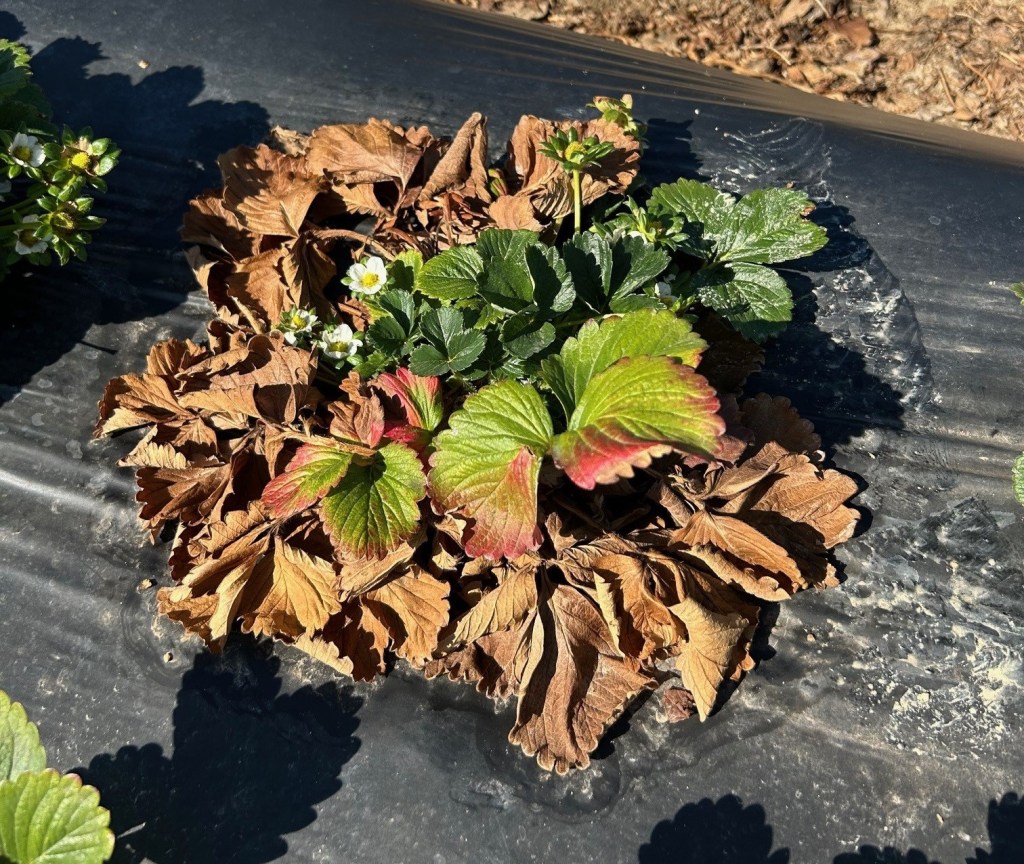
This article focuses on chemical management options for fields affected by Neopest last year and for fields now being planted with Neopest-contaminated transplants. These options include fungicides with proven effectiveness against Neopest, such as thiram, fludioxonil (found in Switch, Alterity, Miravis Prime), and the DMI fungicides propiconazole (Tilt, Topaz, Propi-Star), difenoconazole (Inspire, Inspire Super), and flutriafol (Rhyme). Here are some key points to consider:
- Spray fungicides every 10-14 days when weather conditions are dry, and when conditions are wet, your spray program should be tightened to include a fungicide application every 7-10 days.
- One can apply four Switch applications (or any of the labeled generics such as Alterity) per crop cycle if applied at the full rate of 15 fl oz per acre. If you use the lower rate (11 fl oz per acre), you may apply it five times. Most, if not all, of those applications should be reserved for spring or early summer for fruit rot prevention. And no, you cannot legally use four more applications of Miravis Prime after reaching the maximum number allowed under the Switch label restrictions.
- Thiram solo applications should form the backbone of your spray program to maintain low inoculum levels. It is an effective material against Neopest and Botrytis.
- Before an infection event (significant rainfall at temperatures over 70F), spray a mixture of Thiram with a demethylation inhibitor (DMI) fungicide. Research has shown that propiconazole (Tilt, PropiStar, etc.) can be applied once to planted plugs without affecting plant growth, but this fungicide should not be applied multiple times in a row, as this may cause slight stunting over the course of the season. There is no data on cut-offs, but they may be more vulnerable to propiconazole stunting as compared to plug plants. For cut-offs, we recommend flutriafol (Rhyme) or difenoconazole (Inspire and Inspire Super), which have not shown any inhibition of plant growth on transplants.
Fall application recommendations:
First three weeks after planting and during low-disease-pressure situations:
Thiram SC at 2 to 2.5 qts per acre
or
Thiram SC at 2.5 qts PLUS Rhyme at 7 fl oz (if you must apply a mixture during early plant establishment)
After three weeks and before high-disease-pressure situations
Thiram SC at 2.5 qts PLUS Rhyme at 7 fl oz OR Inspire at labeled rates
followed by (if high-pressure situation persists)
Thiram SC at 2.5 qts PLUS Tilt at label rates (use Rhyme at 7 fl oz if you planted cut offs)
followed by (if high-pressure situation persists)
Thiram SC at 2.5 qts PLUS Switch at 11 fl oz
 The South Carolina Grower