Tom Bilbo, Extension Entomologist
“How are row covers affecting my spider mite pest problems?”
There is a short and easy answer to this question: we don’t really know.
I will be submitting a research grant proposal to tackle this problem and if you are interested in lending your support please read until the end on how you can help.
There is virtually no research published to answer the above question, likely in part because CA and FL strawberry growers don’t use row covers and so much of the strawberry pest management research literature comes from those two states. So at this point, my recommendations regarding row covers and pest management are a best guess using what we know about both how row covers influence the microclimate under them and spider mite/predatory mite biology. Row covers not only protect from low temperatures, but affect overall temperature and humidity, both of which affect mite survival and reproduction, as well as the efficacy and success of predatory mites.
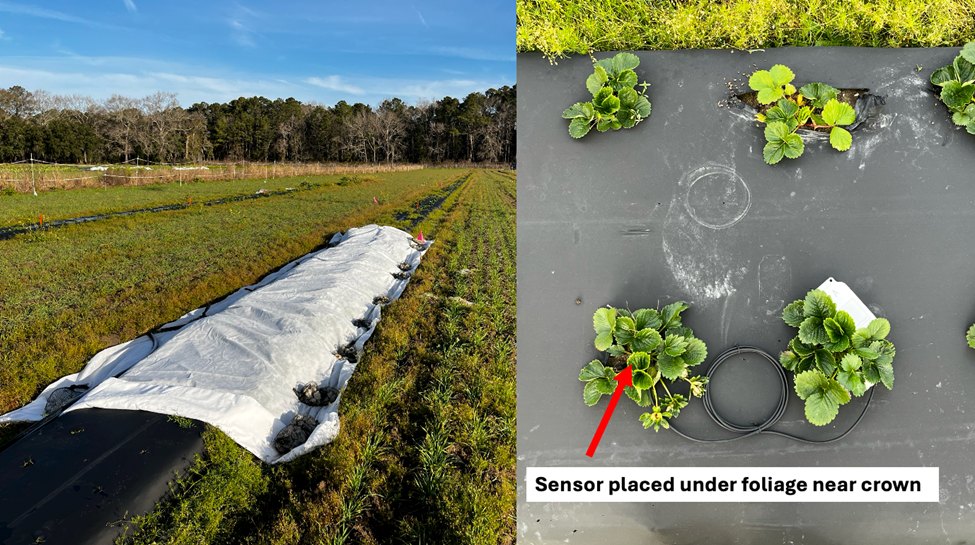
With that caveat, I’d like to share a few of my thoughts about this issue paired with temperature data I’ve been recording at Clemson’s Coastal REC in Charleston, SC the last week where we have had up and down temperatures. I placed temperature/humidity loggers near the crown of strawberry plants under row covers or not. The row cover was 1.5oz weight Agribon AG-50 floating row covers. The weather was sunny or partly-sunny most days of recording.
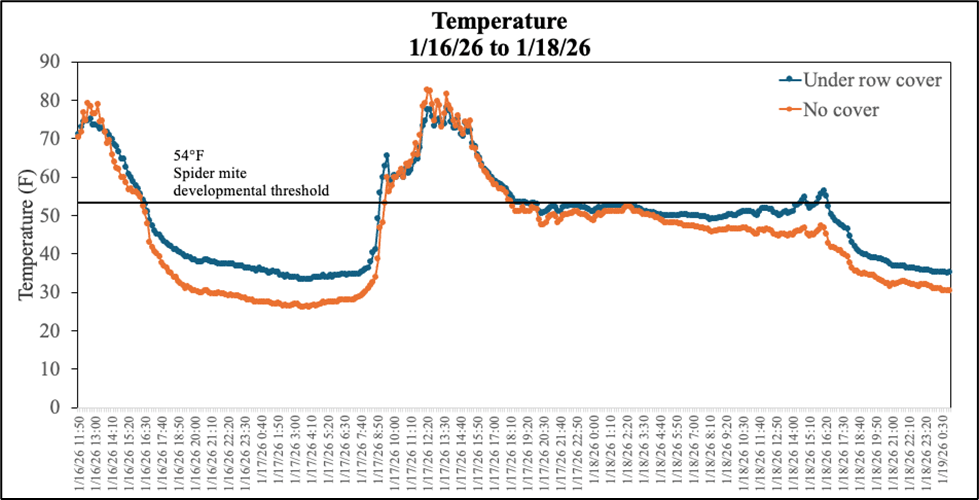
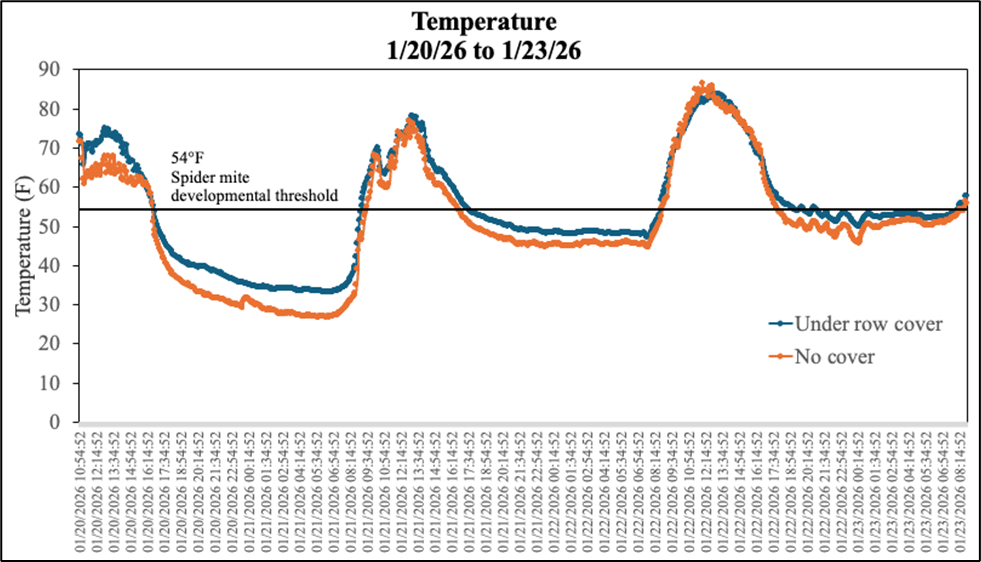
As you can tell from looking at these figures the row covers successfully buffered against nighttime low temps, which were in the 30s to 40s.
The effect on high temperatures was not as apparent, but on two occasions the row cover logger appeared to track nearly 10 degrees higher. Interestingly, on three of the days the peak high temperatures under row covers are less than without row covers—possibly due to buffering against solar radiation and the black plastic mulch.
Overall, temperatures under the row cover were higher at most times.
What does this mean for spider mites?
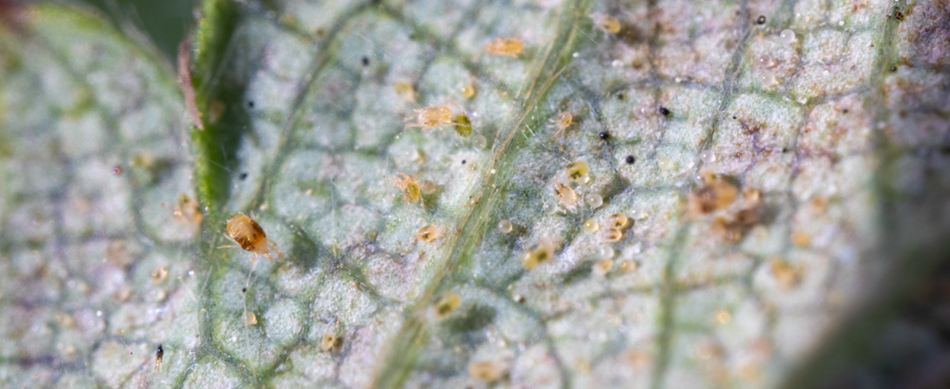
In mild climates such as ours, the twospotted spider mite (TSSM) remains active all winter long. Basically, when it’s warm they will move around, develop (physiologically), and feed, and when it’s cold, they’re at a temporary stand-still. TSSM has a developmental threshold of 54F, so it’s at about that temperature we should expect to see mites becoming active.
TSSM are fairly cold tolerant so there is probably very little TSSM mortality due to cold temperatures in SC. When temperatures are too cold, they have the ability to enter an overwintering diapause stage that protects them. I have not really seen this in SC (midlands and lowcountry), but I saw it frequently in the NC piedmont region during my postdoc years, and it likely occurs in the SC upstate.
The longer that temperatures remain above 54F, the more TSSM will develop. For a simplified example, if uncovered strawberries remain at 50F for three weeks, there would be no TSSM feeding or growth. But if those strawberries were covered and remained at 60F there would be three weeks of slow activity and growth. They develop fastest during hot (80-90F) and dry conditions. Row covers may also exclude natural enemies, giving TSSM free rein without predation.
So, when growers leave row covers on for long periods at a time, it is potentially creating a situation that is allowing a lot more TSSM activity. If row covers have to remain on longer than ideal (e.g. because labor is unavailable) then it also negates the option to spray a miticide.
What does this mean for predatory mites?
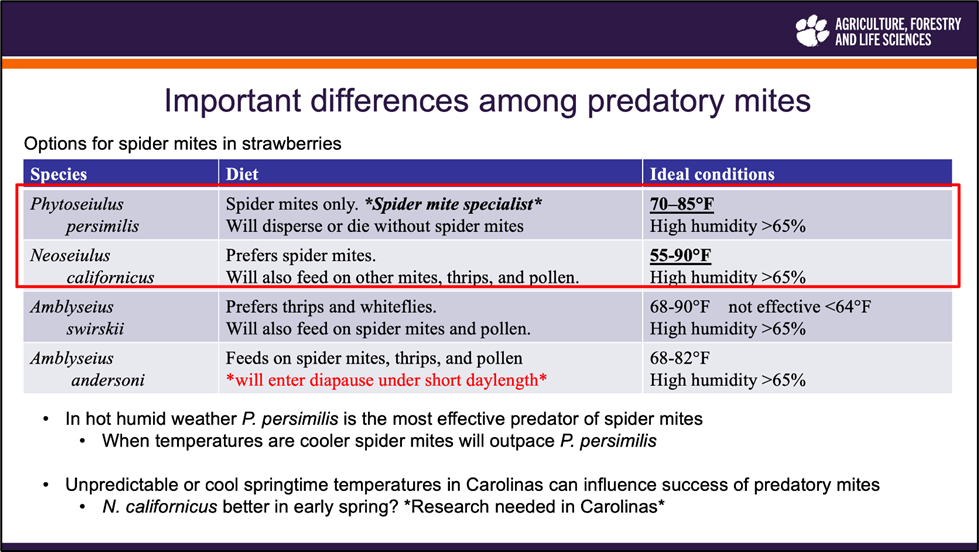
Predatory mites, such as Phytoseilus persimilis and Neoseiulus californicus, are commonly used in strawberry production in FL and CA (and in greenhouses worldwide) because they are voracious predators, highly effective at managing TSSM. But these predators have subtropical origins and perform best in very mild climates when temperatures are above 60F and humidity is above 60%, with severe mortality occurring at freezing temperatures. This creates a challenge for the strawberry production in SC, where we can start to see TSSM problems developing in February-March when it’s not yet warm enough to favor predatory mite success in open fields. I have witnessed less-than-satisfactory results with predatory mites released during this time.
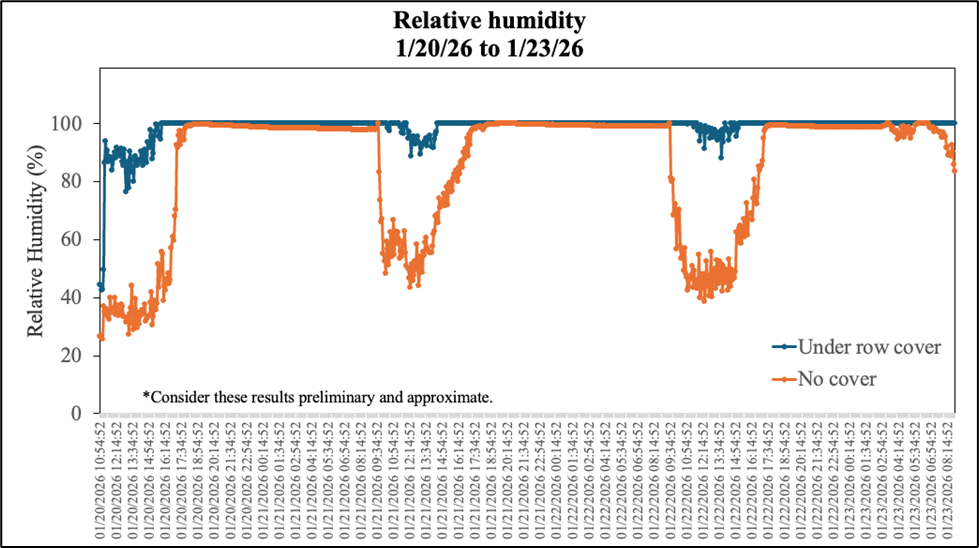
Row covers may change this equation and create an environment more conducive to their success during these early months. In the figures above and below, row covers increase both temperature and humidity. Row covers may create an opportunity to improve predatory mite success in SC, but research is needed to test this.
Final notes on TSSM management
- Scout fields for TSSM regularly, especially when sustained temperatures are >50F. Initial TSSM establishment is aggregated, often along field edges and dirt roads.
- Current recommended treatment thresholds for TSSM are 5 mites per leaflet (pre-harvest) and 10 mites per leaflet during fruiting.
- Scout fields prior to deploying row covers.
- If TSSM are already common at this point, daytime temperatures will be >45F, and the row covers will be on for more than a week, then consider applying a miticide or releasing predatory mites (but consider the forecast and the above criteria required for predatory mite success).
- There are 7-8 miticide options to choose from. None are systemic, but abamectin has translaminar properties. Remember that the label for abamectin states it should be applied twice in a row 7-10 days apart, because it only kills nymphs and adults and the second application is to kill the newly hatched mites. So if you can’t make both applications, consider saving it for later.
- A helpful trick is to mark a flag when you discover early ‘hot spots’ of spider mites. This allows you to revisit the same plants over time to assess if spider mite populations are growing, as well as to assess if applied miticides are killing the mites. It can also be used to gauge the establishment and success of predatory mites.
- Biopesticides such as entomopathogenic fungi (e.g. products containing Beauveria bassiana) have a lot of potential against TSSM and other pests, but are highly UV-sensitive and break down rapidly, so efficacy can sometimes be underwhelming. Row covers may also have the potential to increase the efficacy of these products by limiting UV radiation and increasing humidity.
- If you are interested in this research being conducted so that I can provide more definitive answers and guidance about row covers, spider mites, and biological control—and would be willing to sign a support letter—please email me at tbilbo@clemson.edu. Your support is greatly appreciated!
 The South Carolina Grower