Practical guidelines for maintaining plant vigor, fruit quality, and long-term productivity
By Melissa Muñoz, Small Fruit Extension Specialist
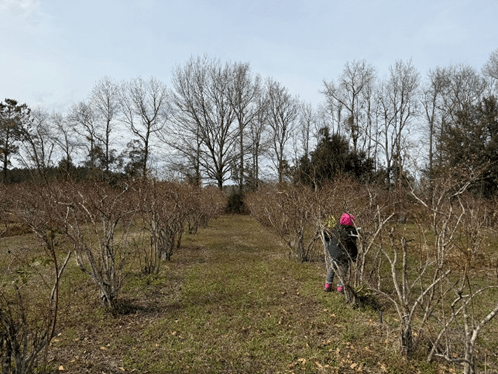
Why Prune Blueberries?
Annual pruning is essential for maintaining blueberry plant health, productivity, and fruit quality. Pruning helps improve berry size, maintain more consistent yields, enhance light penetration and air movement within the canopy, reduce disease pressure, and promote long-term plant vigor.
All blueberry types benefit from annual pruning to maintain proper plant architecture and productivity. Without regular pruning, bushes can become overly dense, produce smaller berries, and develop weak or unproductive wood. Blueberries bear fruit on one-year-old wood, with flower buds formed during the previous growing season. In general, the most productive canes are about 2 to 6 years old, while older canes gradually become less productive.
When To Prune In SC?
In South Carolina, blueberries are best pruned in late winter to early spring, typically from January through early March, after the risk of severe freeze injury has passed but before bud break.
If pruning must be done later in the spring, it is best to complete it just before routine fungicide applications begin, so the exposed tissue receives some protection.
What Tools Are required?
For most major cuts, long-handled loppers will suffice. Hand pruners can be used for the smaller cuts. If pruning hasn’t been performed consistently over the years, the older canes can be very thick and difficult to cut with loppers. In these cases, a compact chainsaw might be beneficial. If pruning diseased canes, make sure to sanitize tools with Ethanol or bleach before moving to a new plant.
Pruning Young Plants (1-2 years)- Establishment
During the first two years, the goal is to encourage strong vegetative growth and establish the framework for future production.
Remove low, weak, or crossing shoots to maintain an open canopy that efficiently captures light. AVOID HEAVY PRUNING AT THIS STAGE!
During the first year, remove flower buds, especially on low-vigor plants. This allows the plant to direct its energy toward root and shoot development rather than fruit production. Let the plant focus on growing strong and not on developing small fruit!
Pruning Mature Plants (>3 years)- Maintaining and Renewing
1. Start with the largest cuts first by removing the oldest canes. Begin by making the large cuts at the base of the plant, then move on to smaller detail cuts. Each year, remove 1–3 of the oldest canes at the base of the plant. If the bush has not been pruned regularly, up to four canes may need to be removed. Older canes are usually gray in color and often covered with lichens. Removing these canes stimulates the growth of new vigorous shoots emerging from the crown.
2. Open the center of the plant. Remove branches in the center of the plant to reduce crowding and allow better light penetration and air movement.
2. Clear the base of the plant. Remove any canes growing outside a 6-inch circle around the base of the plant. This helps maintain a clean crown and prevents weak peripheral growth.
3. Maintain the proper number of canes. Aim to keep 6–10 vigorous canes of different ages per plant.
4. Remove weak or unproductive wood. Eliminate:
- Weak or dead canes
- Crossing branches
- Low-angled canes
- Interior shading branches
- Thin, matchstick-sized shoots
- Dense “broom-like” laterals with few flower buds
5. Finish with smaller detail cuts. After the structural pruning is complete, clean up smaller shoots and minor branches to maintain an open, balanced canopy
Understanding the Purpose of Removing Buds.
Pruning removes about 30-40% of the flower buds, which may appear to reduce yield. However, this helps the plant redistribute resources to the remaining buds, prevents overcropping, and supports more consistent production and plant health over time.
What About Hedging?
Unless a plant needs to be fully renewed (by hedging at knee height), leave hedging for the summer after harvest is complete. Hedging in the spring removes virtually all flower buds. Hedging encourages the growth of new wood, and when done properly, it can reduce the height of the plant, reinvigorate plants, and encourage the development of side shoots.
References
Bill Cline, 2022. Pruning Blueberries. Southern Region Small Fruit Consortium. Available at: https://smallfruits.org/2022/01/pruning-blueberries/
Bryan Hartman and Matt Lenhardt. 2022. Blueberry pruning. NC Extension. Available at: https://stokes.ces.ncsu.edu/news/blueberry-pruning/
 The South Carolina Grower