By Tom Bilbo, Extension Entomologist
Twospotted spider mites (Tetranychus urticae) are the key economic pest of strawberries in South Carolina. They are common in both conventional and organic production systems and reduce the number of berries produced. Spider mites can come into fields on transplants, or blow into fields from nearby host plants or adjacent crops after strawberries are planted. Young plants are especially susceptible to mite feeding, which is why treatment thresholds on pre-fruiting plants are only 5 mites/leaflet or 5% of leaflets being infested (from an average of randomly collected leaflets throughout your fields). When the weather is warm and dry, spider mite populations can grow rapidly. For these reasons, it is important to scout fields regularly starting with received transplants. Early and consistent scouting is the cornerstone of an effective integrated pest management program for spider mites.
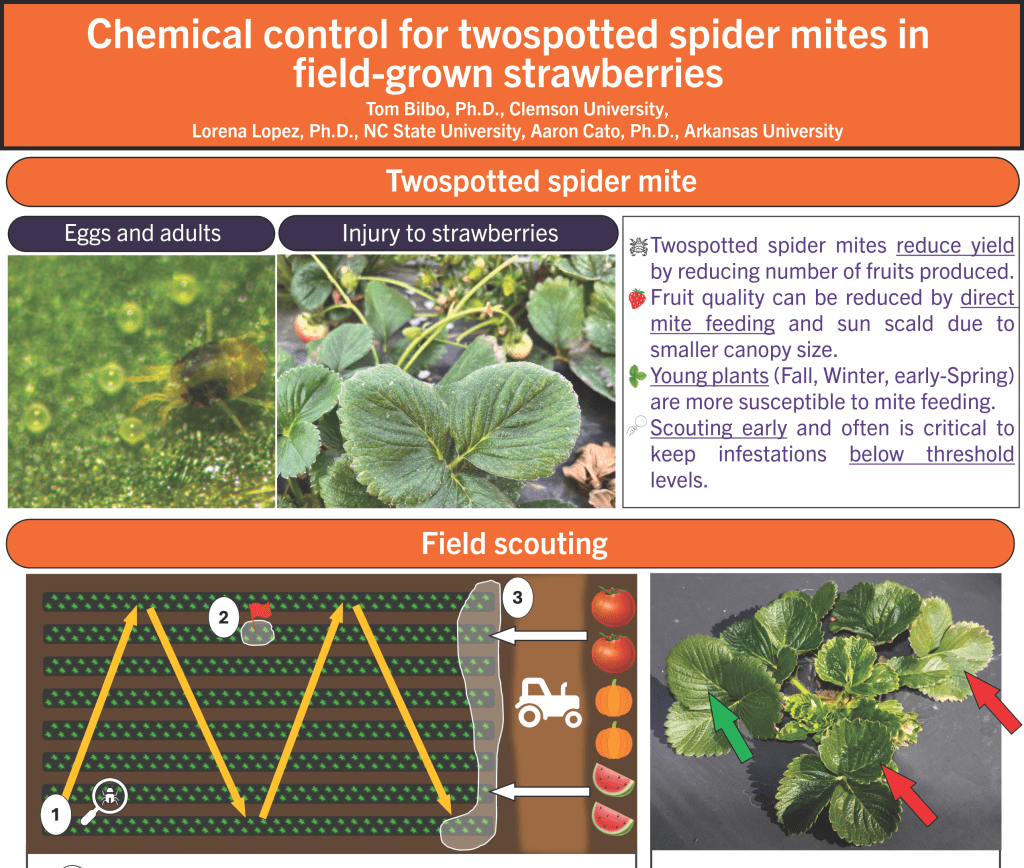
The downloadable and printable guide attached here walks you through everything you need to manage twospotted spider mites effectively with miticides in your strawberry fields — from understanding how mite feeding impacts your crop, to scouting methods and where to look on the plant, to knowing exactly when populations have crossed the threshold that warrants a spray. A detailed miticide selection table is included to help you choose the right product for your situation, with information on life stages controlled, relative efficacy, re-entry intervals (REI), pre-harvest intervals (PHI), and application limits to help you stay both effective and compliant.
The miticide table lists both conventional and organic options. It is important to note that a major limitation of organic products is their lack of residual activity. Achieving direct contact of the miticide on spider mites is crucial for their efficacy, so good spray coverage is required. Apply miticides at the highest gallons per acre allowed (at least 80 GPA;>100 is better).
A future guide will be released detailing how to conserve and release predatory mites and other biological control agents for spider mites in SC strawberries. At the moment, more research is needed to identify reliable and cost-effective predatory mite solutions tailored to SC farms.
Download the guide using the link above and keep a copy handy as you head into the season. As always, be sure to read and follow all pesticide labels, and reach out if you have questions about mite management in your operation.
 The South Carolina Grower
One response to “New Downloadable Guide for Scouting and Spraying Spider Mites in Strawberries”
[…] If you haven’t already done so, check out the downloadable chemical control guide for spider mites in field-grown strawberries. Now that plants are larger and fruiting, they can […]
LikeLike