From Extension Vegetable Entomologist Tom Bilbo
There are three common caterpillar pests that plague growers of cucurbits in South Carolina and elsewhere throughout the Southeast: the squash vine borer (SVB), the pickleworm, and the melonworm. All three are specialist herbivores of cucurbits, which means they (the caterpillar stage) only feed on cucurbits and are specially adapted to do so. This attribute also lends their having strong preferences for one cucurbit species over another (more on that later). As of July, I have already seen SVB and melonworm infesting plants around Charleston, and pickleworm is probably here too. These pests are particularly frustrating because once the egg hatches the caterpillar quickly tunnels into the stem, flowers, or fruit where it is out of sight and then protected from most predators and insecticide sprays.
Squash Vine Borer (Melittia cucurbitae)
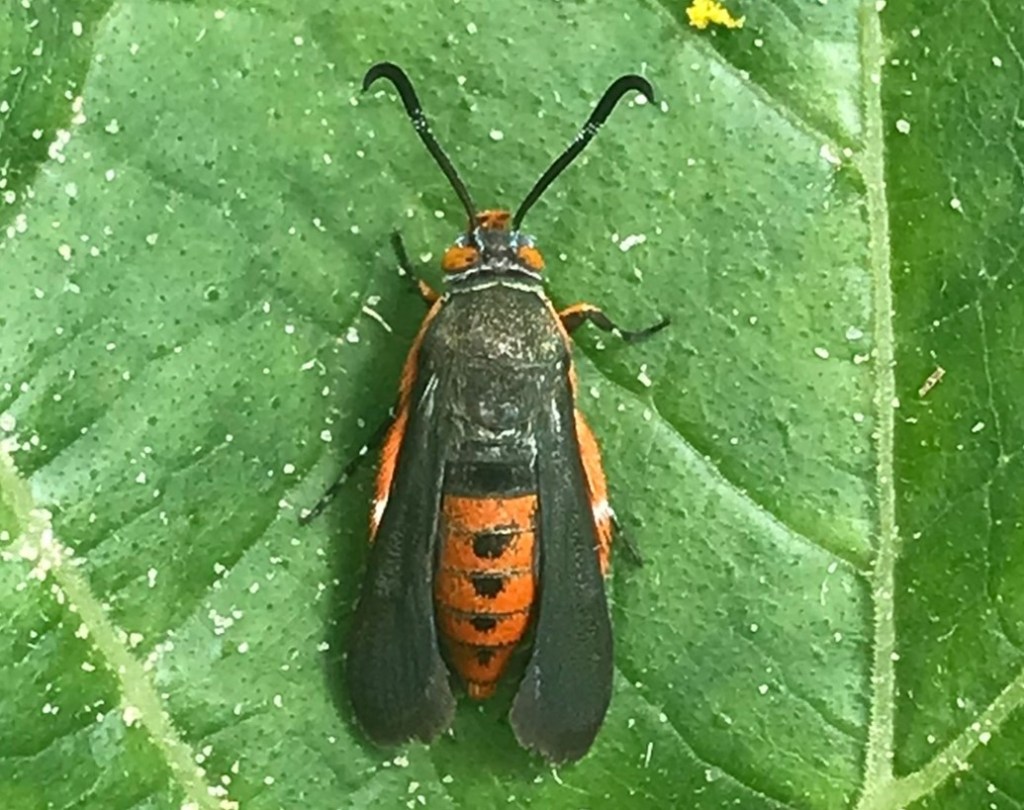
This native species overwinters in the soil in its pupal stage and starts appearing in early-summer depending on spring temperatures. The beautiful clearwing moth is orange and black and lays its eggs on the stems and leaves, usually at the base of the plant. Shortly after hatching, the larva tunnels into the stem where it usually remains until it leaves the plant to pupate under the soil. Larvae in the main stem will cause more damage than those infesting runner vines. Because their feeding within stems cuts off the flow of water and nutrients, infected plant parts will wilt.

Squash vine borer is primarily a pest of squash, zucchini, and pumpkins. It has traditionally been more of a problem for home gardeners and small-scale diversified farms, but large farms can also be impacted with significant loss of fruit yield.
Management: While the principles of managing SVB are the same for home gardeners and commercial farmers, the practicality among approaches will differ:
- Insecticides – Many insecticides are effective against SVB, including pyrethroids (e.g. Brigade®), spinosyns (e.g. Radiant/Entrust®), carbaryl (e.g. Sevin®), diamides (e.g. Coragen®) and Bt products (e.g. Javelin/Dipel®). All of those except Bt are highly toxic to pollinators, and pollinators are very important for cucurbit production. Bt stands for Bacillus thuringiensis—and these products include different toxins that are highly selective to different insects. Bt products for caterpillars will only kill caterpillars that eat it and have very little (if any) impact on other arthropods or wildlife. Bt products are very safe and selective, but need to be reapplied at least weekly to provide continued management.
- Host Plant Resistance – SVB prefers some cucurbits over others, and won’t attack some at all (cucumbers and melons). Cucurbita pepo and Cucurbita maxima varieties are the most attractive. ‘Blue Hubbard’ is so attractive it can be used as a ‘trap crop’ (see below).
- Crop Rotation – Since SVB overwinters in the soil nearby the plant it fed on, plant subsequent cucurbits crops as far away as possible (>1 mile ideally) or every other year.
- Tillage – Since they pupate in the soil, tilling the area around infested plants will kill the pupae.
- Row Covers – Row covers can physically exclude many early season pests such as SVB, cucumber beetles, and squash bugs. However, cucurbits require pollination, so covers need to be removed once flowers develop.
- Trap Cropping – By planting highly attractive varieties at field margins a couple of weeks ahead of the main crop, SVB will be lured to the trap crops where they must then be killed.
A note for home gardeners: many home gardeners want to avoid insecticide use or to only use safe, selective products (a strategy I encourage when gardening is a hobby and not for subsistence). Furthermore, many of the options listed above are not practical or desirable for many home gardeners. Many other suggestions can also be found online, from wrapping your stems with aluminum foil to injecting your stems with Bt or other insecticides. In my own garden I have found the simplest and most effective solution is to spray an over-the-counter Bt product (caterpillar formulated) with a handheld spray bottle 1-2 times a week on the stems and runners of my zucchini, squash, and pumpkin plants. This approach is easy, cheap, fast, and reliable, and I know it is very safe for the pollinators and natural enemies I encourage in my yard. This same approach will also be effective at protecting these plants from pickleworms and melonworms…which we will look at next week in Part 2.
 The South Carolina Grower
One response to “The Pesky Caterpillar Pests of Cucurbit Crops: Part 1”
[…] week, we covered identification and management strategies for the squash vine borer, the first of three common cucurbit caterpillar pests. This week, we will discuss the other […]
LikeLike