What caused this small, toothpick-like mass of sawdust to protrude from from the trunk of this stressed peach tree?
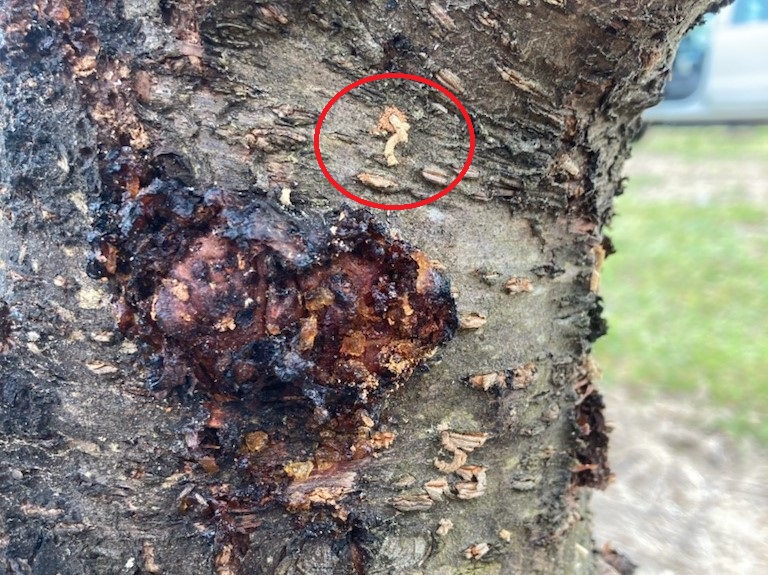
The small toothpick-like mass of sawdust protruding from the tree is often called a “frass toothpick” or “frass noodle”. The structure was created by an adult Ambrosia beetle (Xylosandrus spp.) female tunneling into the tree.
Ambrosia beetles are members of nature’s cleanup crew. They attack stressed, dying, and dead trees. Both native and non-native ambrosia beetles are prevalent in SC. Adult females are 1/8-1/4 inch long and range in color from reddish brown to dark black and are rarely seen because they spend their whole life cycle in galleries burrowed within the tree. When temperatures warm to 70o F, adult females emerge from an infested tree and find a new tree to invade. The female uses her specialized mandibles to burrow into weekend tree bark through the phloem and into the xylem, where she continues forming a large gallery. As the female burrows, she pushes excrement and wood particles out of the entrance hole, which stick together and form the “toothpick” like structures. The entrance holes are perfectly round and 2 mm wide. As the female excavates the gallery, she also introduces fungal spores which she uses to line the gallery. The female carefully selects and cultures the fungi as a suitable food source for her future brood. The ambrosia fungus is a specific species that breaks down the wood.
After the home gallery is ready and the fungus has colonized the walls, the female lays a mass of tiny, white, translucent eggs. The size of the egg mass is dependent on the gallery space and the amount of “ambrosia fungus” available. After hatching from the eggs, the larvae feed on the fungus, instead of the undigestible wood. The larvae undergo several molts prior to pupating and transforming into adults. The sex ratio is 1-10 male to female. The males are wingless and remain in the gallery their whole life. Winged female’s mate with males prior to leaving the gallery in search of a new host. The females exit the same hole that their mother entered. The entire life cycle from egg to adult takes between 55-60 days during the hot, humid summers in the Southeast. Under these conditions, there are generally 2 generations per summer. The females overwinter in the galleries and begin moving out during the months of February and March
Ambrosia beetles are not considered major pests because they select dead and dying trees to attack. They can infect almost every type of tree except conifers, but they prefer dead and dying trees that have soft bark. They are unlikely to infest newly planted fruit trees unless the trees are significantly stressed. The best control measure is to ensure trees remain healthy, and to monitor for damage. If damage is detected on young trees, the following year in early February, set out ethanol traps at the perimeter of the orchard. When the beetles are caught in the traps, spray pyrethroids on the tree trunks to protect the trees. After March, the need to treat decreases. If no damage is seen, it is unnecessary to set traps or treat in the following year.
This week’s question is from Anna Sara Hill, Coastal Region Fruit and Vegetable Agent.
 The South Carolina Grower