From Guido Schnabel, Jeffrey A. Hopkins, Jim Faust, and William Gura
Biological control agents (BCAs) are being promoted for disease management in fruits, nuts, and vegetables but very little data is available about their efficacy especially when it comes to preharvest field performance. The Schnabel lab has investigated yeast-like fungi and true yeast BCAs, namely Botector (SAN Agrow) and Julietta (Agrauxine by Lesaffre), respectively. Botector is registered specifically for gray mold (caused by Botrytis cinerea) and anthracnose (caused by Colletotrichum species) control on grapes, tomato, berries, and other crops. The active ingredient is the yeast-like fungus Aureobasidium pullulans strains DSM 14940 and 14941, which both make up for 80% of the formulation (the rest being other inert ingredients). Once applied, this fungus grows on the surface of plant material and competes with pathogens, such as the ones causing gray mold and anthracnose, for nutrients and space. Julietta is registered for gray mold control of grapes, tomato, berries, and brown rot (Monilinia spp.) control of stone fruits. The active ingredient is a baker’s yeast Saccharomyces cerevisiae strain LAS02, making up 96.1% of the formulated product. Just like Botector, the mode of action of Julietta is based on competition with fungal pathogens on fruits, flowers, and wounds in general.
From experience and based on studies published by others we did not expect the two materials to perform nearly as well as the grower standard. Therefore, we combined the products with a reduced (half rate) of the grower standard (Switch) in hopes that the BCA and the synthetic fungicide standard would synergistically work as well as the grower standard (full rate of Switch). Preliminary lab studies indicated that the active ingredient of Switch (fludioxonil) had no adverse effect on Julietta but did inhibit Botector under controlled conditions. That was an interesting lab result because we concluded the combination of Julietta with Switch might work better for disease management compared to the combination of Botector with Switch.
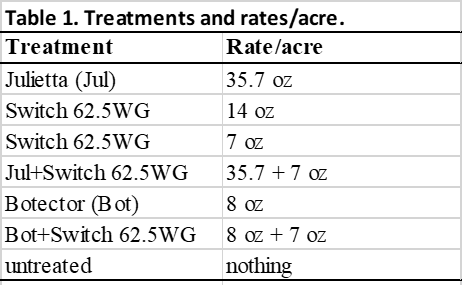
The plasticulture-type field trial (Fig. 1 left) was conducted at Clemson University’s Musser Fruit Research Center (MFRC), Seneca, SC. It was a complete randomized design with four replicate plots per treatment, and each plot contained 20 ‘Albion’ plants (a total of 80 plants per treatment). All treatments were applied at the rates indicated in Table 1 at 100 gallons per acre of water before predicted infection events (based on weather forecasts predicting significant rainfall at temperatures suitable for infection). The treatments were applied at 150 psi with a shielded 5-nozzle half-circle-shaped boom sprayer built to provide turbulent air movement to increase treatment penetration and eliminate spray drift between plots. We collected data twice a week during April and May in the spring of 2024. As part of the data collection and experimental protocol, all ripe and all diseased fruit were removed from the field at each collection. The data in Figure 2 displays the average of three datasets with highest disease pressure. The datasets with the lowest disease pressure were omitted because none of the treatments differed from the untreated control.
The field trial was ‘a success’ in that we did get disease, both gray mold of strawberry and anthracnose of strawberry (Fig. 2 middle and right). The worst case for research is when disease does not show up, and there is nothing to study.
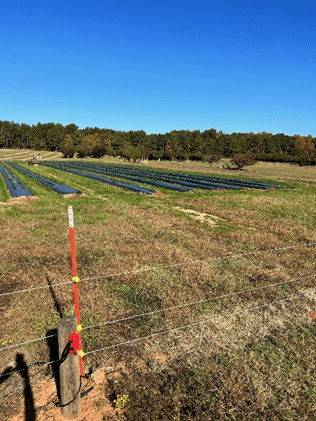
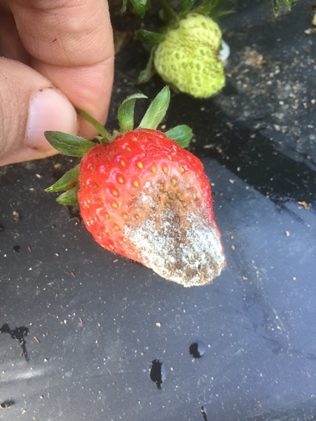

Fig. 1. Images of the field plot at MFRC (left) gray mold (middle) and anthracnose (right) disease.
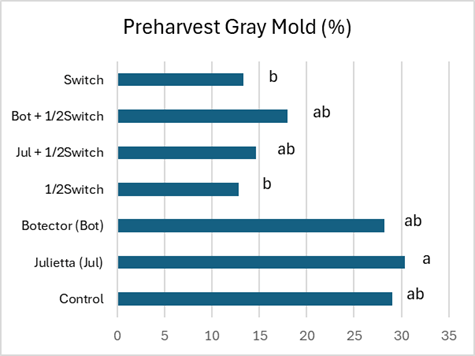

Fig. 2. Effect of experimental treatments on preharvest gray mold (left) and anthracnose (right) development in strawberries. Treatments with the same letters are not statistically different.
We were not surprised the BCAs did not have any efficacy as stand-alone products, but we had hoped the combination of the half rate of Switch with Julietta would be better than either material alone. Interestingly, the half rate of Switch was as effective as the full rate of Switch. In contrast to common belief, applying a reduced rate does not necessarily mean we are selecting more for resistance. The lowest rate of a product with a single mode of action (and thus vulnerable to resistance development) resulting in acceptable control is the rate that should be used.
There are several interesting takeaways from this study:
- The grower standard Switch worked against gray mold and anthracnose.
- The half rate of Switch worked just as well as the full rate of Switch against gray mold and anthracnose.
- The BCAs Botector and Julietta did nothing to suppress the two diseases.
- Neither combination of the half rate of Switch plus Botector or Julietta resulted in synergistic interactions.
In conclusion, the BCAs Botector and Julietta did not do much for us regarding managing strawberry diseases and strategic mixtures of these products with reduced rates of Switch did not show any detectable benefits. Interestingly, the 7 oz rate of Switch (half label rate) was as effective against both diseases as the 14 oz rate. We do not recommend this low rate of 7 oz for practical use. Still, our results suggest that Switch’s lowest recommended label rate (11 oz) should work just fine for strawberry disease control.
 The South Carolina Grower
One response to “Fungus-Based Biological Control Agents: How Useful Are They for Strawberry Disease Management?”
[…] the article Fungus-Based Biological Control Agents: How Useful Are They for Strawberry Disease Management? was published. The article reported our first experience with yeast-based biological control agents […]
LikeLike