By Guido Schnabel
It is early October 2024 and as feared and expected, we are starting to see Neopestalotiopsis symptoms in strawberry fields. The leaf in Fig. 1 (left) displays leaf necrosis and was collected from a South Carolina farm October 4, 2024. Necrosis on leaves can be caused by many things, but if you see small black blisters like the ones in the picture below, you can be sure it is a fungal infection.
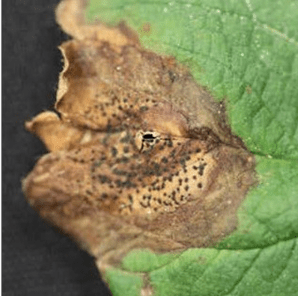
These fungal structures can be caused by Gnomonia or Phomopsis species, which normally are of little concern, or by Neopestalotiopsis, which we are now much more worried about. While studying the necrotic tissue on the leaves with a 10 x hand lens, I saw small black blisters (acervuli) in the area indicated by the red arrow (Fig. 1 left). I put the leaf in a zip lock bag with a moist paper towel and within two days, thin spaghetti noodle-like rods with spores oozed from the small black blisters. As they grew, the rods bent and formed an O-ring (middle picture). This picture was taken after five days in my makeshift moist chamber. The rods (conidiomata) consist of spores that can only be visualized under a microscope; the picture below on the right was taken at 400 x magnification. These spores are the real identifier for a particular fungus.

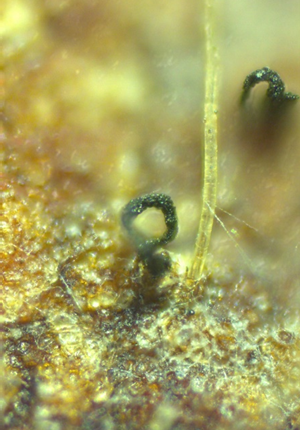

Fig. 1. Images of leaf necrosis (left), fungal rod-shaped structures (middle) forming from black blisters, and conidia (right) produced by Neopestalotiopsis.
The farmer was notified, but he already knew it was coming based on all the previous warnings that were provided by the nurseries and extension professionals. Best management practices as well as fungicide recommendations can be found in the below-listed extension articles and in the MyIPM smartphone app.
Acknowledgement
Thanks to the South Carolina Small Fruit Grower Association for in-kind support.
Relevant Literature
Schnabel, G. 2024. Sometimes, the underdog wins the spotlight. Southern Region Small Fruit Consortium August Newsletter p. 6-8. https://smallfruits.org/category/small-fruit-news/summer-2024/ .
Brannen, P. and G. Schnabel 2024. Dramatic Neopestalotiopsis disease in strawberry nurseries. The South Carolina Grower, Clemson Cooperative Extension, August 21, 2024. https://scgrower.com/2024/08/21/dramatic-neopestalotiopsis-disease-in-strawberry-nurseries/
Schnabel, G., P. Brannen, and Bill Cline 2024. Recommendations for fall treatments in strawberry crops with known presence of Neopest. The South Carolina Grower, Clemson Cooperative Extension, September 27, 2024. https://scgrower.com/2024/09/27/recommendations-for-fall-treatments-in-strawberry-crops-with-known-presence-of-neopest/
 The South Carolina Grower
One response to “And So It Begins…Neopest is Starting to Show Up.”
[…] Dramatic Neopestalotiopsis Disease in Strawberry Nurseries SC Grower Exchange-September Deep Dive: Neopestalotiopsis in Strawberries Recommendations for Fall Treatments in Strawberry Crops with Known Presence of Neopest And So It Begins…Neopest is Starting to Show Up. […]
LikeLike