From Guido Schnabel, Hehe Wang, Juan Carlos Melgar, Ayodeji Idowu, Junaed Ahmed, Rongzhong Ye, and Michael Vassalos
I think we can all agree that peaches produced in commercial peach orchards in South Carolina are special. They are sold locally at farm stands and many retail stores along the East Coast. You may not know that 10-40 percent of all harvested fruit does not meet retail standards and is often discarded. This includes fruit with spots caused by the bacterium Xanthomonas arboricola pv. pruni, commonly known as the causal agent of bacterial spot, or bacteriosis.
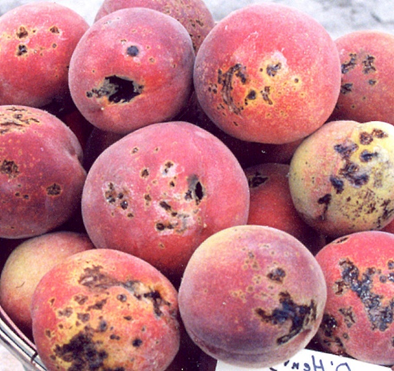
Hehe Wang (plant bacteriologist) located at the EDISTO Research and Education Center in Blackville, SC is interested in suppressing bacterial spot in commercial peach orchards. Bacterial spot management has relied on season-long chemical spray programs with copper and oxytetracycline (an antibiotic). However, oxytetracycline resistance and copper tolerance have recently been found in the bacterial pathogen populations in South Carolina peach orchards. Wang has been working with Guido Schnabel (plant pathologist), Juan Carlos Melgar (pomologist), Rongzhong Ye (soil scientist), and Michael Vassalos (agricultural economist) to assess biological pesticide sprays as alternative and more sustainable options for the spray programs and specific soil treatments for their ability to suppress bacterial spot and increase the percentage of fruit that meet industry standards. They hypothesize that healthier soils lead to healthier trees and less disease. Therefore, the goal of this project, funded by the USDA Southern SARE program, was to strengthen the sustainability of both conventional and organic peach production systems in the Southeast. This work is being done in collaboration with peach producers.
Three years into the study, the team can share some interesting findings. Graduate student Junaed and his advisor Wang investigated biological spray programs on spring canker management. Spring cankers are the most important inoculum sources for leaf and fruitlet infections. Applications of biological Bacillus subtilis (Theia, Certis Biologicals) during fall leaf drop consistently reduced spring canker incidence and severity up to 70% based on two years of study. Copper (Kocide 3000) and other biological products also reduced spring canker, but the efficacy was lower than Theia. Theia applications during the growing season also reduced bacterial spot, but the effect was not as prominent compared to the dormant application mentioned above. Its application every 7-10 days reduced bacterial spot without causing phytotoxicity on leaves. Among all chemical and biologicaltreatments, copper was still the most effective in reducing bacterial spot. Still, its continuous application caused phytotoxicity, which could impact fruit yield and quality for late-season cultivars. Perhaps Theia could be an alternative option to copper and be integrated into future spray programs to reduce phytotoxicity and improve disease management.
In addition to spray applications, graduate student Idowu and his advisor Melgar looked at soil management practices to make trees healthier and less susceptible to bacterial spot. Incorporating soil amendments such as composted food waste or mulch before and after planting reduced bacterial spot incidence and severity. Soil amendments reduced the conventional fertilizer needed between 50% and 100%. Depending on the timing and amendment volume applied, the trees may not need to be fertilized for several years. Soil amendments reduced pathogenic nematodes that can harm peach roots, and increased soil water holding capacity, nutrient cycling and availability, organic carbon, microbial biomass, and microbial activities, while maintaining or improving tree water and nutrient uptake, tree yield, fruit quality and whole tree physiological functions. The extent of these improvements depends mainly on the sources of the amendments, soil types, and management history. The study also indicated that more is not always better. Adding too much organic material can saturate the soil without benefitting the tree.
 The South Carolina Grower