From Clemson Plant Pathologist Tony Keinath
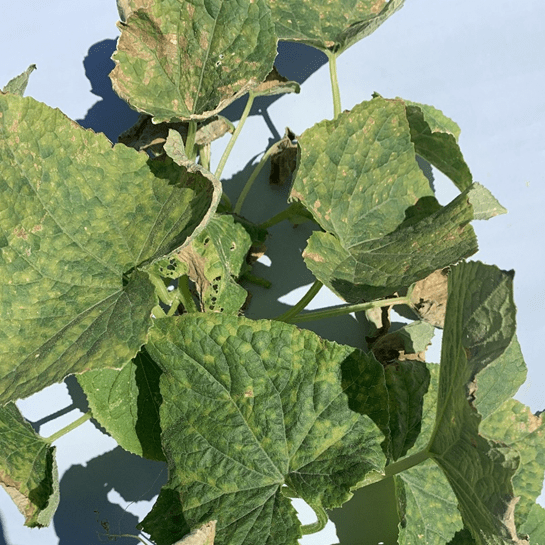
In fall 2024, fungicide programs were tested on ‘Gershwin’ pickling cucumber to find out which programs worked best. Eight fungicide programs (plus a non-sprayed control) were used with various combinations of chlorothalonil (Bravo), Ranman, and Orondis Opti (Orondis + Bravo pre-mix). Cucurbit downy mildew (CDM) symptoms were noticed on Sep. 13, 2024. (Keep this date in mind.)
For simplicity, I condensed the eight fungicide programs into three groups, based on the fungicides applied, because fungicides had a much greater effect on CDM and yield than the scheduling did. All three fungicides reduced CDM compared to the non-treated control (measured as final leaf disease severity on Oct. 7, DS4% in the graph below), and each fungicide differed from the other two. Orondis Opti/Ranman was more effective than Ranman and Bravo, and Ranman was more effective than Bravo.
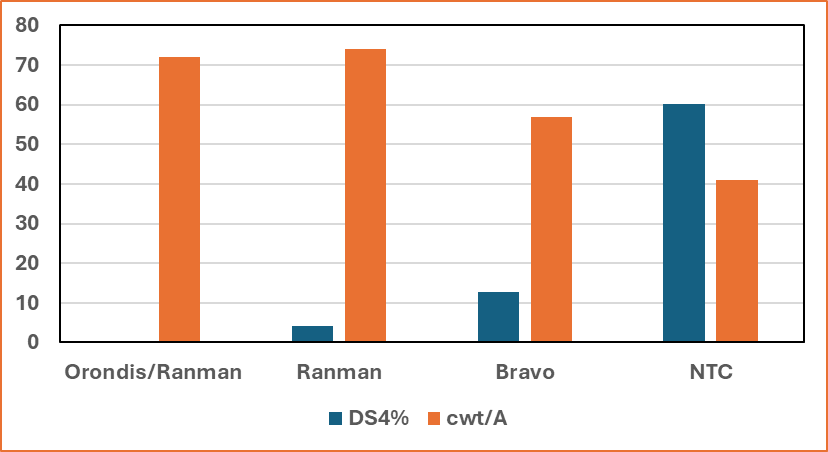
The pattern was different for marketable yield of No. 1, 2, and 3 pickling cucumbers, harvested 13 times (3 times per week). Orondis Opti/Ranman and Ranman yielded more than the non-treated control (NTC). Yields with Bravo were in the middle and didn’t differ from the other three treatments. Thus, to get the best yields, spraying only Bravo isn’t good enough.
Here is the fungicide application sequence for each program. Note that models 1, 2 and 3 (early versions of a CDM disease forecaster) did not call for a spray on Sep. 5 because of dry weather. I want to point out 5 important differences among schedules early in the season.
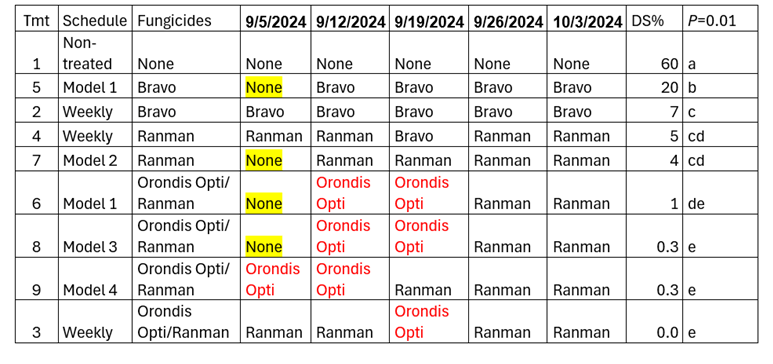
1. All 8 fungicide programs reduced CDM compared to the non-treated control (a versus b, c, d, and e in the last column).
2. The first Bravo spray was omitted Sep. 5, based on Model 1. It looks like CDM spores arrived sometime after Sep. 5 but before Sep. 12, based on disease severity (DS%) and the spray schedule. As a consequence, treatment 5 had more CDM than all other fungicide programs for the entire season! This lasting effect illustrates the importance of timely sprays on a weekly schedule, especially for growers who are relying on inexpensive contact fungicides like Bravo or mancozeb.

3. In contrast, when the Ranman spray was omitted on Sep. 5, CDM in treatment 4 was not worse than in treatment 5 sprayed on Sep. 5. The similar levels of CDM illustrate the curative effects of Ranman that reduced CDM even when it was sprayed a few days after infection.

4. Orondis Opti also had curative activity against CDM.

Important Note: I do not like using the term “curative” with fungicides, because I am very concerned some growers will get the wrong idea that they can wait and spray fungicides until they see disease symptoms. (Using “curative,” however, is the only way to explain points 2, 3, and 4). Waiting to spray fungicides until disease is noticed is very risky, so I do not recommend it for any vegetable diseases. The best curative fungicides for CDM, like Ranman and Orondis products, are curative only in the very early stages of CDM, that is, before you can see leaf spots. Once leaf tissue has turned yellow, the window for a curative effect is closed and locked, and the leaf spot will continue to expand and turn brown, even with future sprays.
5. One application of Orondis Opti on Sep. 19 was better than one application of Bravo. Given that Orondis Opti is curative, and Bravo is not, this result is not surprising.

The lack of symptoms (that I noticed) in treatment 3, however, is surprising until we consider the weather. Fall 2024 was unusually dry in Charleston, the driest in the 33 years I’ve worked at Coastal REC. Rainfall in September was only 60% of normal. October set what must be a new record for lack of rain, with only 0.03 inches recorded for the month, 1% of the typical 4.3 inches. Thus, all fungicides performed unusually well in this trial.
Note that for a five-spray fungicide program, only 1 application of Orondis Opti is allowed per the label, as treatment 3 received. For research purposes, 2 applications were made in treatments 6, 8, and 9.
Based on this trial, a 2025 fungicide program of Ranman every other week (1, 3, 5, 7, 9) alternated with Orondis Opti (week 2 and 6) and Bravo (week 4 and 8) would do a great job protecting pickling cucumber from CDM.

