From Clemson Plant Pathologist Tony Keinath and Clemson Postharvest Physiologist Karin Albornoz
In the past 2 weeks, two agents reported enlarged lenticels on potato tubers harvested from wet soil. This disorder (or abiotic plant problem problem) is most noticeable on red-skinned potatoes when the surface is wet. Enlarged lenticels are not a disease problem, but according to a report from North Dakota, they can provide easy access for soft rot bacteria.
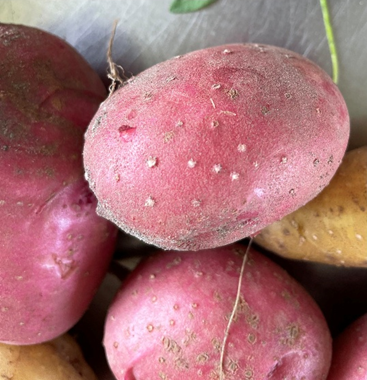
Under normal conditions, lenticels appear as tiny brown specks 1/16 of an inch long and scattered over the surface of a potato tuber. Normally, we associate lenticels with woody plants, because they are the pores in the bark on stems of shrubs and trunks of trees. Lenticels are also found on potato tubers, because tubers are modified stems. Lenticels allow tubers to breathe underground.
In wet soil, the soil pores are filled with water instead of air. In an attempt to take in more oxygen, lenticels expand. The extra growth pushes up and out of the lenticels, making them noticeable.
If the skin is scrubbed off a tuber with expanded lenticels, small, shallow, brown spots may be visible on the flesh. In 98% of the cases, these spots are removed during peeling. Deeper spots may need to be removed with the tip of a paring knife.

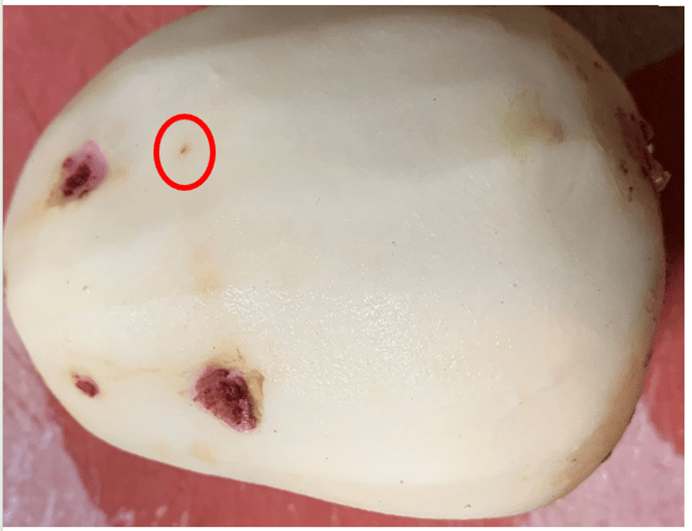
In my opinion, expanded lenticels are not a reason to cull potato tubers. Expanded lenticels do not affect the texture or taste of the tuber, but they can affect visual quality, and therefore, tuber salability for some markets, e.g. grocery stores.
In addition, potato specialists in North Dakota warn of an increased risk of soft rot developing on potato tubers with expanded lenticels. Coincidentally (or maybe not), one of the growers who reported expanded lenticels also had one (or more) tubers with severe soft rot. Soft rot, caused by a bacterium, is one of the biggest risks when harvesting late spring/early summer crops of potatoes in South Carolina.

Growers who plan to store these tubers with expanded lenticles, or tubers harvested from wet soil in general, should take extra precautions to make sure the tubers are not bruised during harvest. Bruising, unfortunately, is more common when potatoes are harvested in wet soil. Tubers must be dry when placed into storage to prevent development of soft rot and other postharvest diseases. See the article in The Potato Grower for other management tips.
 The South Carolina Grower