What type of bird made its nest in this blackberry bush?
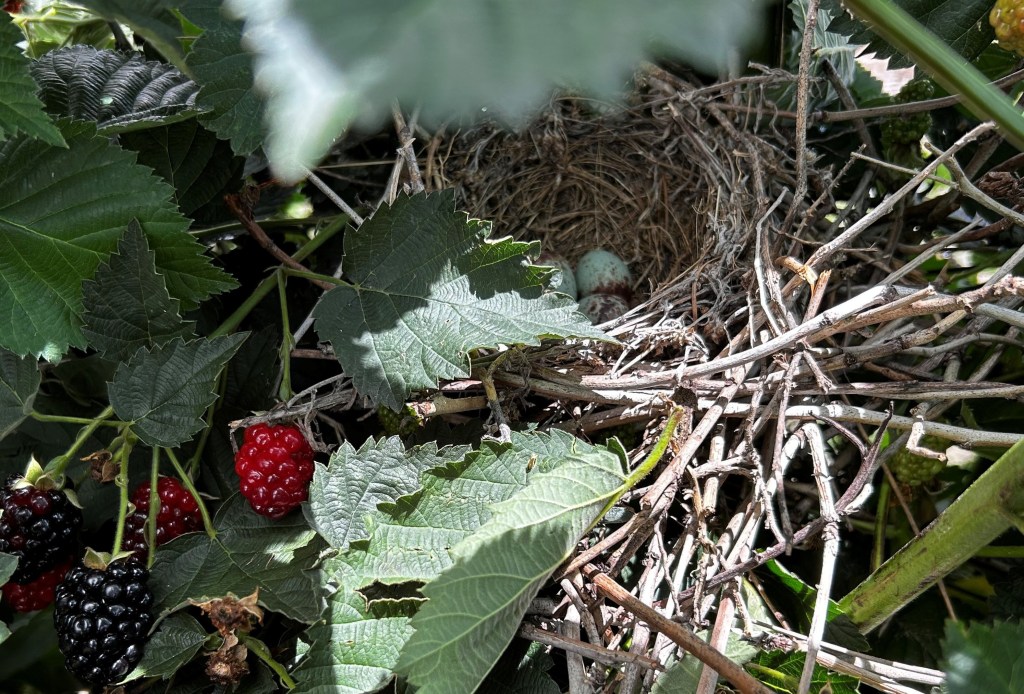
This nest, and blue eggs with brown speckles, are that of the Northern mockingbird. Northern mockingbirds are the state birds of Texas, Florida, Arkansas, Tennessee, and Mississippi. Their breeding range stretches from Southeast Canada, south to the Greater Antilles, and west to California. The species is also found in the Hawaiian Islands and parts of the Caribbean. The only mockingbird endemic to North America, they live year-round across most of their range.
Males choose the nest site and begin constructing the outside of the nest using dead twigs. He will start several nests before the female comes and selects one to finish up. She will use roots, leaves, feathers and other materials to line the inside. Mockingbirds breed prolifically. It is not uncommon for a pair to have three broods in a year. Nests are rarely reused.
Females lay clutches of 2-6 eggs and incubate them for around 12 days. One overachieving female set a record by laying 27 eggs in a single season (National Audubon Society). After hatching, the nestlings are cared for by both parents, taking turns bringing food and protecting the nest. Approximately 11-12 days after hatching, the nestlings fledge. They continue to be fed, but are taught to hunt and care for themselves for the next two weeks. Sometimes the male will raise the fledglings while the female sits on a second batch of eggs.
Both males and females are highly territorial and will aggressively dive bomb or chase other birds, humans, cats, or other intruders. Males use flight displays to attract a mate by showing their white wing and tail feathers. Both sexes flash white feathers to ward off larger predatory birds such as hawks and owls.
The taxonomic name for Northern mockingbirds is Mimus polyglottos, which, translated from Latin, means “many-tongued mimic”. They are talented singers with a repertoire of approximately 100 tunes, imitating sounds from their environment, including man-made sounds and other animals. John James Audubon said of the Northern Mockingbird, “There is probably no bird in the world that possesses all the musical qualifications of this king of song, who has derived all from Nature’s self”.
To learn more intriguing facts about Northern Mockingbirds, read 10 Fun Facts About the Northern Mockingbird | Audubon
This week’s question is from Anna Sara Hill, Coastal Region Fruit and Vegetable Agent.
 The South Carolina Grower