Johanna Wesche and Guido Schnabel, Clemson University
Biologicals are gaining interest in modern agriculture for several reasons. They are used in organic farming to suppress pests and diseases and may have a place in spray programs used in conventional farming when disease pressure is low, when fungicide efficacy is threatened by resistance development, or when increased restrictions or cancellation of conventional products require the application of alternatives. For example, the Endangered Species Act lawsuit settlement and the greater focus on farm worker protection by the U.S. Environmental Protection Agency (EPA) mandates stricter rules for multisite fungicides thiram and captan. Both are cornerstones for small fruit (thiram and captan) and tree fruit (captan) spray programs.
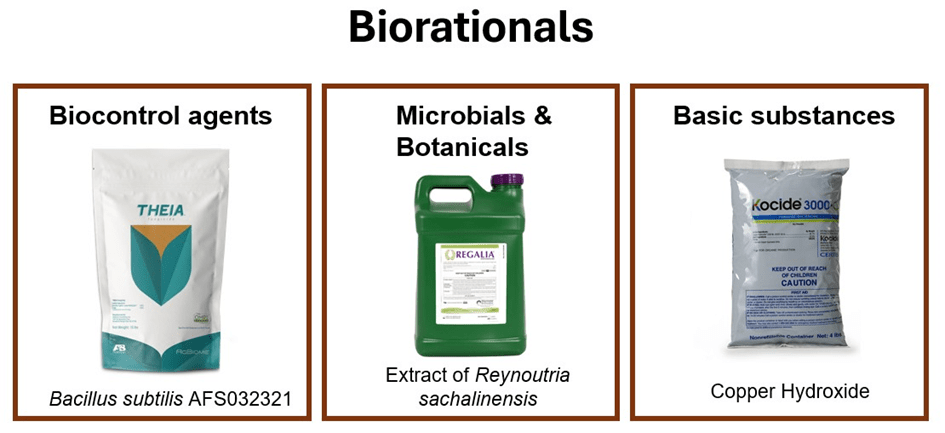
This article provides a brief overview of non-synthetic ‘Biorationals’ and discusses their modes of action. We divide Biorationals into Biocontrol Agents (BCAs), Microbials and Botanicals, and Basic Substances.
Biocontrol Agents (BCAs)
A unique feature of BCAs is that they contain living microorganisms capable of suppressing plant pathogens. These microorganisms, which include bacteria, fungi, and yeasts, were obtained from the plant environment – either from the soil or from plant surfaces. Companies screen thousands of microorganisms to identify those with the highest efficacy against pathogens. Once identified, they are mass-produced and formulated into commercial products for agricultural use.
BCAs can act through multiple modes of action. They may parasitize pathogens directly or produce antimicrobial compounds and metabolites that can kill or inhibit the pathogen’s mycelia or spores. Commercial BCAs may include metabolites and antimicrobial compounds from the fermentation process alongside the microorganisms themselves. BCAs may also compete with pathogens indirectly for nutrients and space, thereby reducing pathogen activity. They may also enhance the plant’s natural defenses and make it more resilient to infections.
Examples of commercial BCAs include:
- Theia (Certis): Contains the bacterium Bacillus subtilis AFS032321.
- Serenade Opti (Bayer): Contains the bacterium Bacillus subtilis QST 713.
- Double Nickel (Certis): Contains the bacterium Bacillus amyloliquefaciens D747.
- Serifel (BASF): Contains the bacterium Bacillus amyloliquefaciens MBI 600.
- Julietta (San Agrow): Contains the yeast Saccharomyces cerevisiae LAS02.
- Botector (Agrauxine by Lesaffre): Contains the yeast-like fungus Aureobasidium pullulans DSM14940 and DSM14941.
- SoilGard (Certis): Contains the fungus Gliocladium virens GL-21.
- BotryStop WP (Bioworks): Contains the fungus Ulocladium oudemansii U3.
- RootShield WP (Bioworks):Contains the fungi Trichoderma harzianum T-22 + Trichoderma virens G-41.
The efficacy of BCAs is influenced by the quality of the product, such as their relatively short shelf life, and their ability to colonize the host surface, which is dependent on temperature and moisture after application, the host tissue itself, and more.
Microbials and Botanicals (M&Bs)
M&Bs do not contain living organisms, but they do contain fungicidal extracts from plants or microorganisms. Unlike BCAs, M&Bs do not have to establish themselves in the environment to compete for space and nutrients or produce pathogen-inhibiting substances. Thus, they are not as dependent on environmental factors to achieve pathogen suppression.
Examples for commercial B&Bs include:
- Howler EVO (Certis): Based on the metabolites of the rhizobacterium Pseudomonas chlororaphis AFS009.
- OSO 5% SC (Certis): Contains Polyoxin-D zinc salts, naturally occurring bacterial metabolites produced by Streptomyces cacaoi.
- Trilogy (Certis): Clarified Hydrophobic extract of Neem Oil
- Thyme Guard (Agro Research International): Essential oil made from thyme oil.
- Prev-AM (Rovensa Next): Based on orange oil.
- Timorex Gold (STK): Contains tea tree oil.
- Regalia (ProFarm): Contains an extract of Reynoutria sachalinensis.
- Fracture (FMC): Contains Band of Lupinus albus.
Basic Substances
This group of fungicides contains copper and sulfur products, which play a key role in organic farming. Other products include chitosan or calcium salts; calcium chloride has shown efficacy against gray mold. Basic Substances are based on simple chemical structures and classified by the FDA as GRAS (Generally Regarded As Safe) products. Their mode of action is general in nature (not site-specific), which do not make them vulnerable to resistance development by the pathogen. They typically are cheaper compared to other biorational fungicides.
Examples for Basic Substances include:
- Basic Copper 53 (Albaugh): Basic Copper Sulfate (53.0% copper).
- Champ WG (Nufarm): Copper Hydroxide (50.0% copper).
- Kocide 3000 (Certis): Copper Hydroxide (46.1% copper).
- Cueva (Certis): Copper Octanoate (Copper soap) (10% copper).
- Microthiol Dispress (UPL): Micronized wettable sulfur (80.0% sulfur).
- Sulfur 80 WDG (Drexel): (80.0% sulfur)
- Fosphite (JHBiotech): Mono- and dipotassium salts of Phosphorus acid (53.0%).
- Amour-Zen (Botry-Zen): Chitosan (15.0%).
- Dow Flake Extra (Oxy-Chem): Calcium chloride flakes (83.0 – 87.0%).
In summary, there are many kinds of Biorationals that are sold for disease management of specialty crops. They range from living organisms, to fermentation products, to basic minerals.
 The South Carolina Grower
One response to “Biologicals Made Easy: Grouping and Understanding Biological Fungicides”
[…] fungicides and the fungicide insensitivity of Neopestalotiopis sp. In our recent article, “Biologicals Made Easy: Grouping and Understanding Biological Fungicides,” we introduced different groups of biological fungicides and their modes of action. We grouped […]
LikeLike