The warm weather has made strawberries, peaches, and blueberries jump. Strawberries are in full swing now and it’s a great time to visit the U-Picks. Moisture in the forecast this week is likely to bring an increase in disease pressure. See details below.
Keep an eye on the Upcoming Events tab periodically so you don’t miss any of our winter/spring meetings. Also, check out the latest episode of the SC Grower Exchange Podcast below.
Don’t forget to look at our Resources tab for links to crop handbooks, helpful websites, and related blogs. Be sure to scroll all the way to the bottom to see this week’s Question of the Week, and check back on Thursday for the answer.
Statewide
Tony Keinath, Extension Plant Pathologist
- Basil seedlings with symptoms and signs of downy mildew were found at Home Depot in the West Ashley area of Charleston on Sunday, April 6. Leaves had typical symptoms of one-sided yellowing or small necrotic spots. Typical signs of purplish “fuzzy” areas on the undersides of diseased leaves indicated the presence of spores. The seedlings were grown in a greenhouse in Greensboro, Georgia. There is a risk of spores spreading to local basil plants.
- All organic growers and home owners in the Charleston area should spray susceptible basil cultivars with a half rate of potassium phosphite as a precaution. Use the half rate to prevent marginal necrosis and apply only enough product to wet the upper leaf surfaces; it’s not necessary to spray until run-off.
- Any cultivars with “DMR” in the name are resistant to basil downy mildew and do not need to be sprayed

Coastal Region
Anna Sara Hill
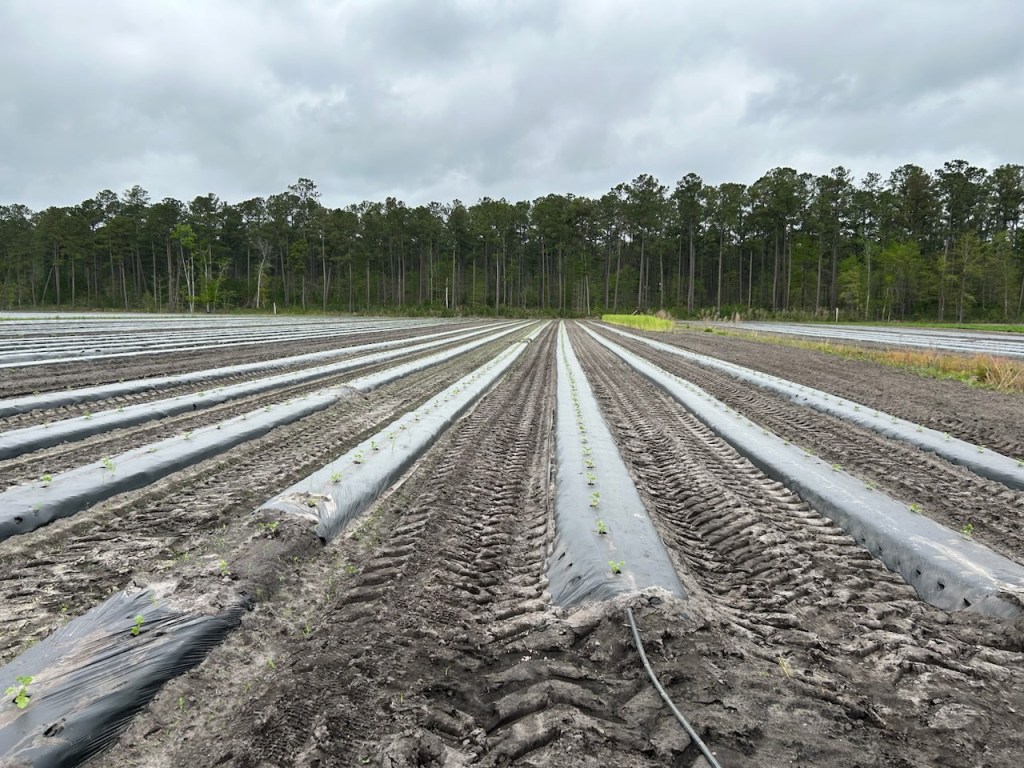
- Watermelon growers are busy in the field transplanting. Some growers are planting grafted plants while others are not. The plants look good thus far.
- Keep an eye out for thrips, I noticed one watermelon field that had a healthy population of them. Although, they can do some damage if left unchecked. Its best to monitor them. Products containing Flonicamid are very effective if treatment is required. However, if the field has a history of cucumber beetles and an injection to control them is required, chemical products with a 4A MOA also have some activity against thrips. Remember to read and follow all label instructions and always rotate MOAs. Also, check the recommended action threshold levels for the specific crop being treated prior to applying the pesticide.
- Blueberries appear to be developing nicely and should start showing color in a few weeks.
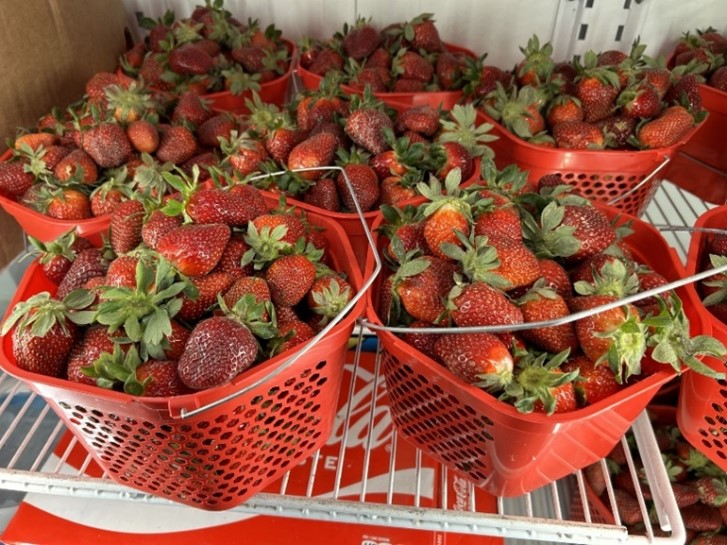
- Strawberries are being harvested hot and heavy. Continue monitoring and treating as needed for spider mites and diseases as there is still a lot of berries still developing.
Zack Snipes
- It warmed up rather rapidly last week. We are in a huge strawberry flush right now with heavy volumes coming in.
- I am seeing very little in terms of disease on berries but spider mite populations have picked up. Thresholds this time of year are 15-20 mites per leaflet. I see most plants are relatively mite free and then you will have a few plants that are absolutely loaded with them. With this warm weather, I expect populations to increase this week. You have to take in account pre-harvest intervals and picking days when choosing a miticide. If you hit a mite threshold on Thursday, can you afford to not pick on Friday and Saturday?
- Other crops are looking good with no serious issues.
Midlands
Sarah Scott
- Peaches are starting to really move and we are entering into our summer cover spray programs. Growers along the Ridge should keep an eye out for plum curculio. They have been observed in traps in Ft. Valley, GA, so they should be showing up anytime. This is the first generation that has overwintered from last season, so blocks that had issues last season should be checked carefully. The second generation can be seen anywhere from late May into July.
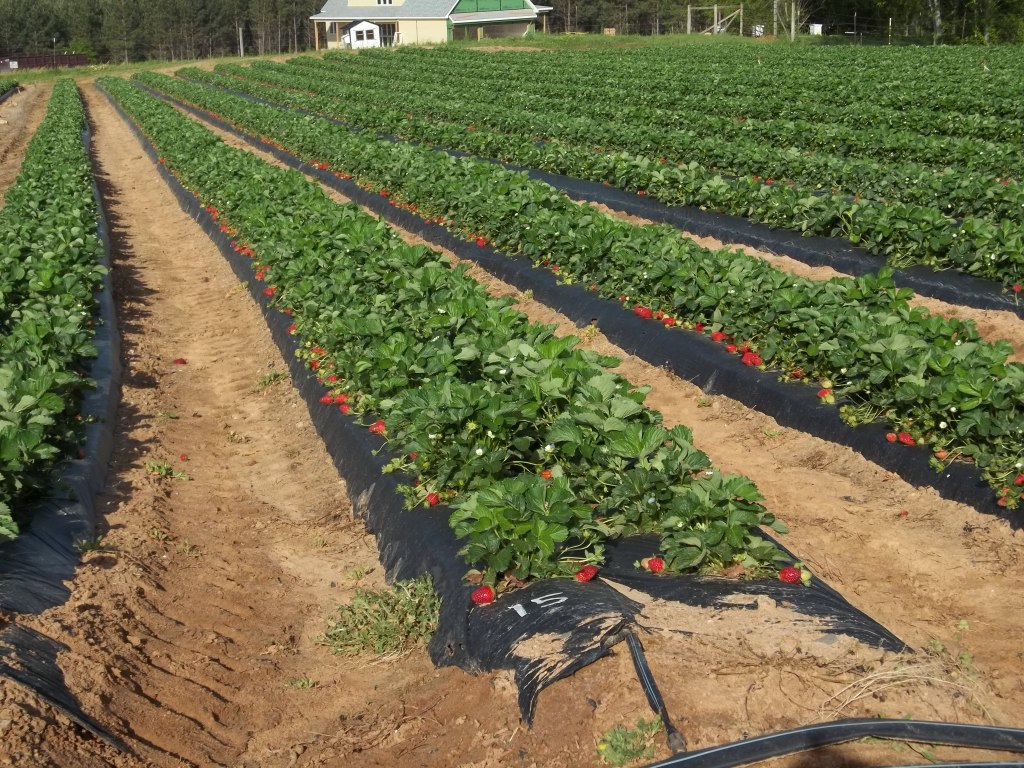
- Strawberries are producing well and we are moving into more consistent ripening. No huge issues present as of now, but we will keep an eye on things as the temperature warms up and we get some rainy days.
- Blueberries are loaded up, much like last year
- Summer vegetables have been going in the ground over the past week including bell peppers, cucurbits and some tomatoes.

Upstate
Andy Rollins
- I found plum curculio on plums last week. I spoke with Brett Blaauw (Entomologist responsible for SC Peachs) and he is recommending using Imidan at the label rate. He reminded me that Imidan needs to be applied with water at a pH of 5.5. If growers are using well water, the pH is already in that acidic range and adjustments don’t need to be made. For growers using municipal water systems the water is pH adjusted close to 7. In this case Li700 or other acidifiers, should be added to the spray tank first while agitating, then other pesticides including Imidan. Normal recommendations are to add dry flowables and powders before liquids, but in this case the pH should be adjusted first.
- I am also finding stem cankers on peaches of unknown origin.
- Strawberry production is beginning in the Upstate with some ripening of berries on smaller plants. I found an odd leaf symptom that appears as water-soaked lesions, especially on the bottoms of the leaves, and progresses along the veins of the leaves. There is a new bacterial disease of strawberry found in Florida (Pseudomonas spp.) that is a possibility, but this has not been verified yet. As a precaution until identified, I recommended 1 lb of Kocide 3000 be applied as long as we continue having regular rain events.
- Strawberry growers need to be doing their leaf samples and making sure their petiole nitrogen is up to the needed 3000ppm, and that their orchard leaf samples show no deficiencies in other plant essential nutrients.
- Increased rains will increase our disease pressure. Please remember it is better to get a protectant fungicide like Thiram or Captan on strawberries before rain events rather than trying to control after. And good coverage is extremely important.

Question of the Week
What happened to this strawberry? (Hint: not a disease)

Answer in the comments below and check back on Thursday to see the answer.
 The South Carolina Grower