From Clemson Plant Pathologist Tony Keinath
Key Takeaway for Growers: Grains or grasses cropped 1-2 years before pickling cucumber can help reduce cottony leak.
The acreage of pickling cucumber fluctuates in South Carolina. Growers who are growing or considering growing this cucurbit should be aware of three fruit rots that are difficult to control with fungicides. Belly rot, Phytophthora fruit rot, and cottony leak put the crop at risk from yield losses. Recently, cottony leak has been the greatest concern.
Sampling of diseased fruit in Calhoun and Bamberg counties in 2022 and 2023 yielded two culprits: the expected Pythium aphanidermatum and the new Pythium deliense. Both species are warm-season Pythiums (water molds), so it’s not surprising they were found on samples collected in July through September. Pythium deliense was also recovered from a few cucumber plants with “pinched” stem lesions.
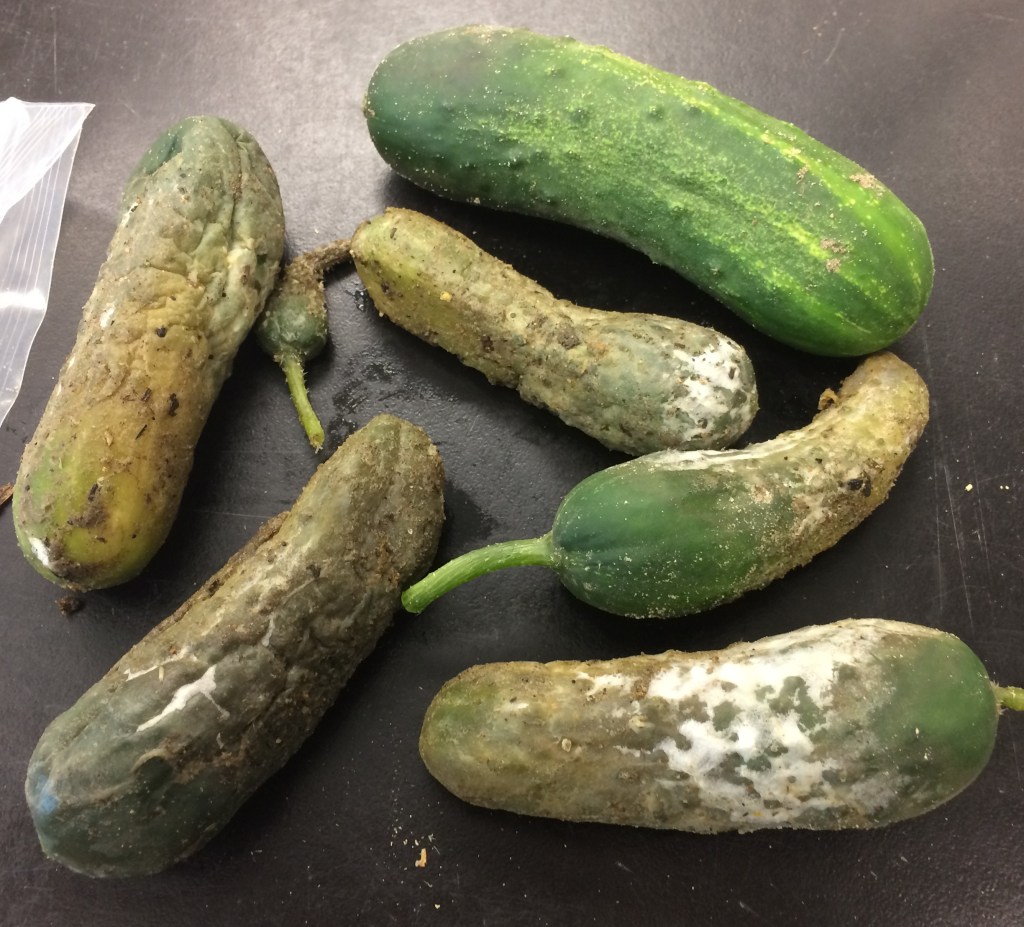
Cottony leak appears as a soft, wet rot on pickling cucumber, with white mold covering most of the fruit.
Fungicides are not really an option for managing cottony leak. First, Orondis products are ineffective against Pythium. Second, Ridomil products can be applied only to soil, not over the top of a crop. Third, Ridomil applied at seeding does not last until fruit are set. Fourth, it’s basically impossible to get fungicide under the fruit lying on the soil. These constraints require a look at cultural practices to manage cottony leak. In the sampled fields, Pythium (and cottony leak) were less common in fields cropped to ‘Coastal’ bermudagrass 2 years before pickles than in fields cropped to peanut or soybean (Table 1). Bermudagrass is not susceptible to either Pythium species; however, soybean is susceptible to both species, and peanut pods are susceptible to P. deliense, based on work done at the University of Georgia. My best guess is that pods persisting in the ground after harvest allowed P. deliense to persist or to infect cotton seedlings the following year, allowing enough Pythium to remain in the soil that it infected the cucumbers.
Table 1. Data on cottony leak and prior crops grown in rotation with pickling cucumber from a survey done in 2022 and 2023.
| Crop 2 years prior | Susceptible | Crop 1 year prior | Susceptible | % Pythium Recovery |
| ‘Coastal’ bermudagrass | No | Corn or watermelon | Yes | 55 |
| Peanut or soybean | Yes | Cotton | Yes | 83 |
This statistically verified association of cottony leak with Pythium-susceptible rotation crops led to the following table, showing which field crops are susceptible to the two Pythium species recovered from cucumbers with cottony leak.
Table 2. Common field crops in South Carolina that are susceptible (Yes) or not susceptible (No) to 2 species of Pythium causing cottony leak.
| Crop | Pythium deliense | Pythium aphanidermatum |
| Pickles | Yes | Yes |
| Bermudagrass | No | No |
| Corn | No | Yes |
| Cotton | Yes | Yes |
| Hemp | No | Yes |
| Peanut | Yes | No |
| Rye | No | No? |
| Sorghum | No | No |
| Soybean | Yes | Yes |
| Tobacco | Yes | Yes |
| Wheat | No? | No |
Growers planning a pickle crop in 2027 should look over their crop rotation records to choose fields with a lower risk of cottony leak developing, based on the previous crops grown. Growers planning farther ahead can look at the list of crops in Table 2 and choose appropriate rotation crops for fields to be planted to pickling cucumber in 2028.
Crops not susceptible to Pythium deliense should be prioritized. This species was found on 85% of the sampled fruit, so it represents the greater risk. (The crops with designations of “No?” are crops with one report of susceptibility that I judged to be less than convincing.) It is clear from Table 2 that the “best” (least risky) rotation crops for pickling cucumber are grains and grasses.

