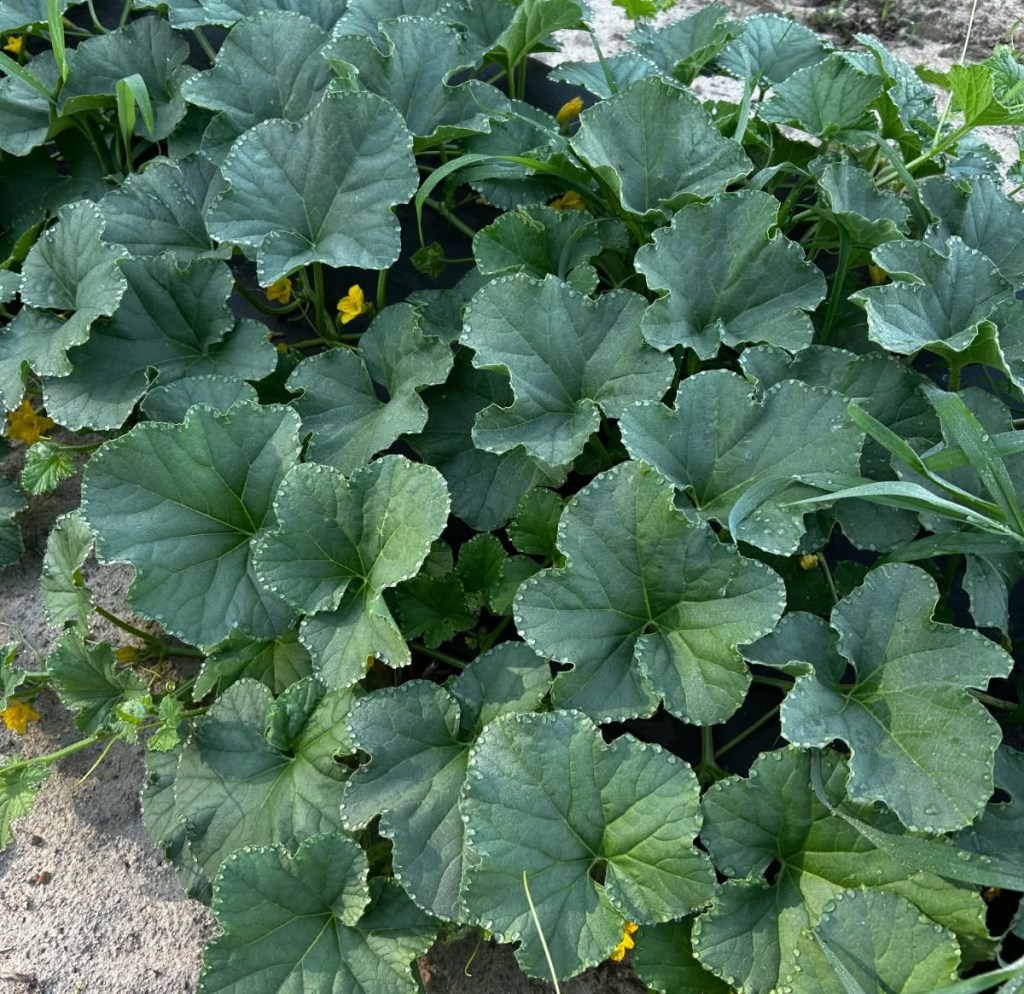
What causes these water droplets to form around the margins of these cantaloupe leaves?
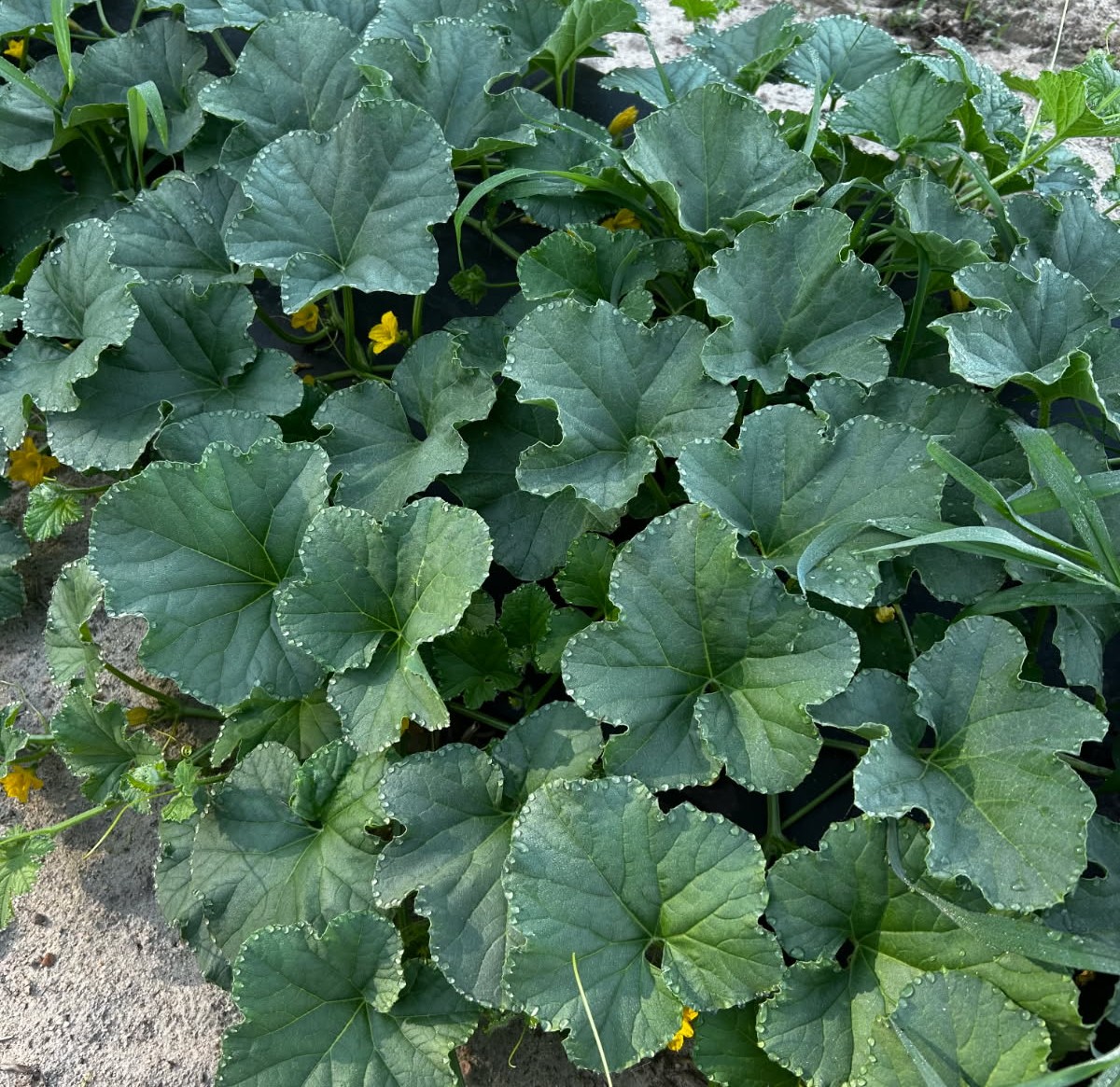
This interesting occurrence is known as guttation. Guttation is a biophysiocochemical and physiological phenomenon exhibited in many members of both the plant and fungi kingdoms. The root word “gutta” is Latin for drops and is commonly known as “leaf teardrops”. It is an accurate depiction of the “water” welling up in the plant and seeping from the tips, edges or surface of uninjured leaves. This phenomenon is commonly seen on grass blades in the early morning and is often mistaken for dewdrops. A highly uniform pattern distinguishes guttation droplets from dew drops.
The “water” exuded during guttation is actually a combination of translucent fluid that consists of xylem and phloem sap, as well as dissolved minerals and salts. Sometimes the minerals are left behind as a white, crusty residue after the droplets have dried.
The fluid is exuded from pores called hydathodes, which are always open, unlike stomata, which open and close to regulate gas exchange and transpiration. Hydathodes are located on the leaf margins where the veins end, hence the uniform pattern on leaf margins.
Guttation is most frequently observed early in the morning or late in the evening, when the plant’s transpiration rate is low, stomata are closed, humidity is high, and/or the soil is holding more moisture than the plant roots can access. When the transpiration rate is low, roots pump minerals into the xylem, and water moves from the soil into the roots through osmosis, causing a positive hydrostatic pressure buildup in the roots. The root pressure pushes the fluid up through the xylem and out through the hydathodes.
For years, guttation was considered an insignificant process in plants. However, recent research has revealed that guttation is more than a vital plant survival mechanism. It benefits the ecosystem and other organisms. It can also serve as a valuable diagnostic indicator in agriculture.
This week’s question is from Anna Sara Hill, Lowcountry Fruit and Vegetable Extension Agent.

